
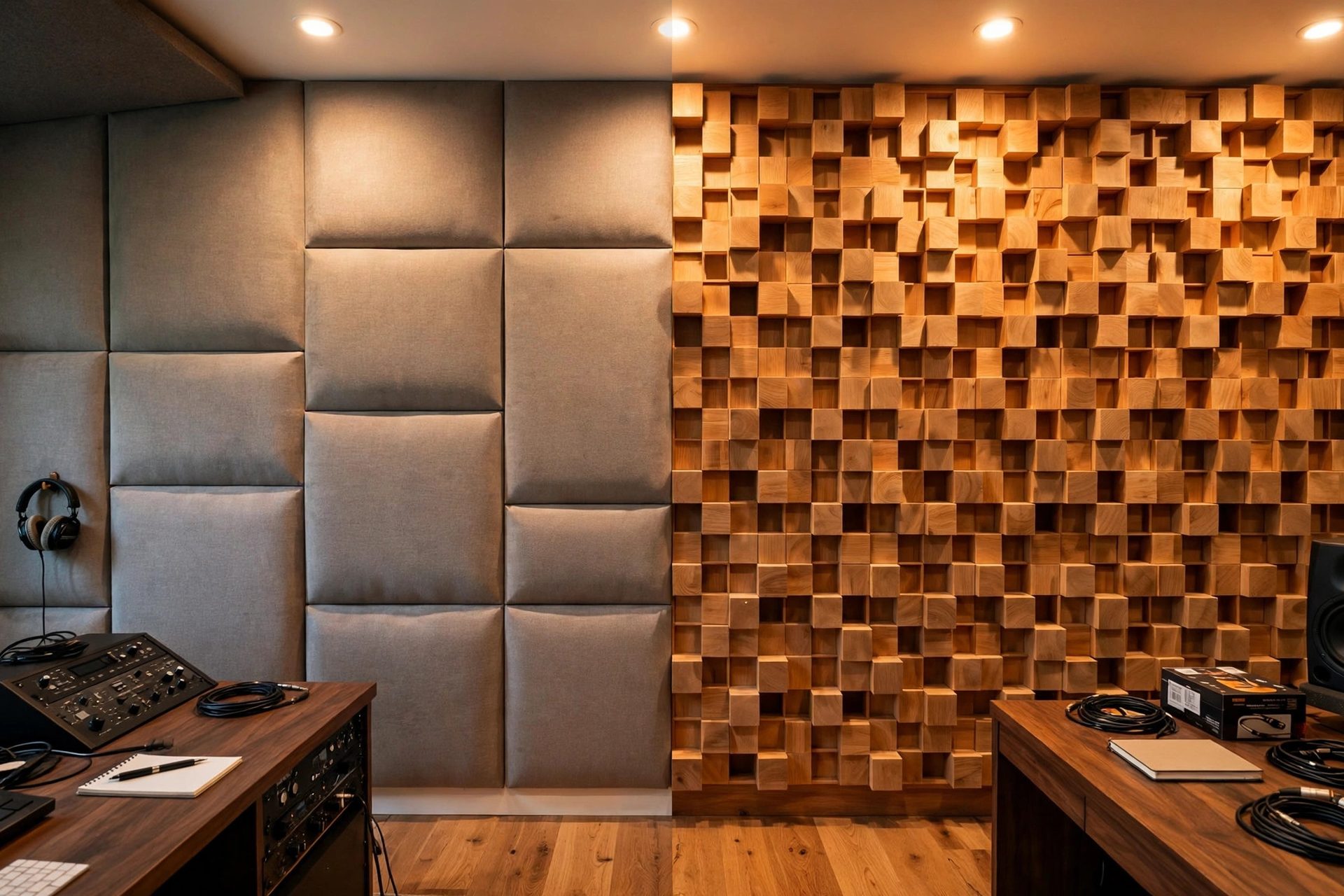
Wood that works, not just wood that looks good
Walk into a restaurant, an office lobby, or a school hall that sounds calm, and look at the walls. There is a good chance some of that calm is wood. Wooden acoustic panels have become the treatment people choose when they want the room to sound better without looking like a recording studio. They look like design. They work like treatment, and that is the whole point.
They are not decoration pretending to be acoustics, and they are not foam hiding behind a wood print. A real wooden acoustic panel is a wood face with holes or grooves cut into it, fixed over a layer that soaks up sound. The wood is the face you see. The holes are the door the sound walks through. The layer behind does the quiet work.
What a wooden acoustic panel actually is
Start with the face. It is usually a wood veneer on a stable core, or a solid wood panel machined to shape. Then the maker cuts a pattern into it. Three patterns cover almost everything you will see in the Silentical catalog. Perforated panels have round holes drilled in a regular grid. Grooved panels have long slots milled across the face. Microperforated panels have tiny holes, so small you have to look close to see them, spread evenly across the surface.
Behind the face sits the absorber, usually a polyester fiber felt or a mineral wool layer. The panel mounts on a wall or a ceiling with a small air gap behind it. That gap matters, and we will come back to it. The whole assembly, face plus absorber plus gap, is what does the work. The face alone would bounce sound around like any other hard surface.
How the holes do the work
Sound is air moving, and a hard wall sends it straight back. A hole in the face gives that moving air somewhere to go. It passes through the opening, enters the soft layer behind, and the fibers turn its energy into a tiny amount of heat. Less energy comes back into the room, so the echo drops and voices get clearer.
Different patterns catch different parts of the sound. Bigger holes and wider grooves let more sound through and reach deeper into the middle range, the range where voices live. Tiny microperforations work mostly on the higher frequencies, the hiss and sizzle that make a room feel sharp. That is why a panel is not just a panel. The pattern is the tuning, and the tuning decides which part of the noise it tames.
The air gap behind the panel is the other half of the tuning. A bigger gap reaches lower sounds, a smaller gap keeps the panel close to the wall. Installers use the gap the way a guitar maker uses the body of the instrument, to set which notes the panel answers. Mount the same panel flat against the wall with no gap and no backing, and most of the benefit disappears.
What they fix, and what they do not
Wooden panels fix the sound inside the room. They shorten the echo, so a voice stops bouncing after a short time instead of hanging in the air. They calm the flutter echo between two parallel walls, the ringing repeat you hear when you clap in a bare hallway. They take the sharp edge off a restaurant, a classroom, or a conference room, so people can talk at a normal volume and actually hear each other.
What they do not fix is sound getting in or out. A wooden panel has no real mass and no seal, and blocking sound needs mass and sealing. If your neighbor hears your television through the wall, panels will not stop it. If the meeting room leaks every word into the hallway, panels will make the meeting sound better inside the room and do nothing for the hallway. That job belongs to mass, sealing, and decoupling, the heavy work of soundproofing, and no panel changes that.
This is the most common misunderstanding in the whole product line, and it costs people money. Panels are treatment, not isolation. Buy them to fix how a room sounds. Buy mass and sealing to fix what escapes it.
Where they earn their place
Restaurants are the classic case. Hard floors, glass, and bare tables make a dining room loud, and a wooden panel ceiling or a band of panels on the back wall can pull the echo down without changing the look of the room. The wood fits the design, so owners say yes to treatment they would have refused in fabric or foam.
Offices and conference rooms are next. A meeting room with glass on two sides and a hard table sounds terrible on a video call, and panels on the wall behind the camera and on the ceiling above the table clean up the voice without turning the room into a studio. Schools use them in halls and music rooms, houses of worship use them where the sermon has to reach the back row, and home studios use them where the look matters as much as the sound.
At home they belong in the living room with the hard floors, the dining room with the high ceiling, and the home theater where the dialogue gets lost in the echo. If a room looks finished and sounds harsh, wooden panels are usually the right first step.
Picking the right pattern
Match the pattern to the noise. If the problem is voices and general chatter, a perforated or grooved panel in the middle range is the workhorse. If the room sounds sharp and hissy, with clattering plates or bright music, microperforated panels take the edge off the top end. If you are not sure, measure first. A short noise study shows which frequencies are doing the damage, and the pattern follows the measurement instead of a guess.
Then match the finish to the room. Wood species, stain, and groove spacing all change the look, and the catalog carries perforated, grooved, and microperforated panels in the finishes people actually ask for. A panel that clashes with the room will get taken down, and a panel on the floor treats nothing, so pick a finish you will live with.
Coverage matters more than the pattern. A few panels scattered like pictures on a wall do almost nothing. A band across a ceiling, a full wall behind the noisiest seats, or a cloud over a table gives the sound somewhere to go. A rough rule is to treat a good share of the hard ceiling or the largest bare wall, then listen and add more if the echo is still there.
Installation, and the mistakes to skip
Install them the way they were designed to be installed. Keep the absorber behind the face, keep the air gap the maker specifies, and fix the panel flat so it does not rattle. A rattling panel adds noise instead of removing it, and a panel with no backing is a decoration.
Skip the usual mistakes. Do not cover every wall, because a dead room sounds as strange as a live one. Do not expect panels to block sound to the next room, because they will not. Do not buy them before you measure, because the measurement tells you whether the ceiling, the walls, or the floor is doing the damage. And do not hide them behind furniture, because sound cannot reach a panel it cannot see.
If your room is loud enough that people raise their voices, or the echo makes video calls hard to follow, request a free quote at silentical.com/quote/ or call (716) 330-1147. Tell us what the room is made of, where the noise comes from, and what the room is used for, and we will tell you which pattern fits and how much coverage the room actually needs.