
Walk into most warehouses and the first thing you notice is the sound. Forklift beeps, rolling doors, conveyor belts, compressors, people calling across the floor. And underneath all of it, a long echo that keeps every noise alive for seconds longer than it should. That echo is not just annoying. In a big hard-surfaced building, it makes real noise problems worse, and it is the first thing to fix.
Why warehouses are so loud
Warehouses are some of the hardest buildings to keep quiet, and the reasons are structural. You have huge volumes of open space, high ceilings, and almost every surface is hard: concrete floors, metal decking, steel racking, gypsum or metal wall panels. Sound bounces off all of it. In an office, carpet, furniture, and partitions soak up a lot of sound. In a warehouse, there is nothing to soak it up, so every noise lingers and overlaps with the next one. The result is reverberation that can make a moderately loud space feel twice as loud as it measures.
The sources themselves are usually no mystery. Forklifts and pallet jacks, conveyor lines and sorting equipment, loading dock doors, HVAC and compressed air systems, and backup alarms. Knowing which sources matter most is important, because treatment works best when it targets the dominant noise rather than the background.
Start by measuring before you buy anything
The most common mistake we see is buying acoustic panels based on a square footage estimate, with no measurements and no plan. A proper approach starts with understanding the room. A short on-site survey with a sound level meter tells you the actual noise levels, the reverberation time, and which frequencies are causing the trouble. Low rumbling equipment noise and high frequency beepers need very different treatment.
As general guidance, workplace noise in the United States is covered by OSHA regulations: employers are expected to have a hearing conservation program when workers are exposed to high levels over an eight-hour day. A survey tells you whether you are anywhere near that territory, which affects both your treatment plan and your liability. You do not need lab-grade precision for planning purposes, but you do need real numbers.
The treatment playbook
Once you know what you are dealing with, warehouse treatments fall into a few clear categories.
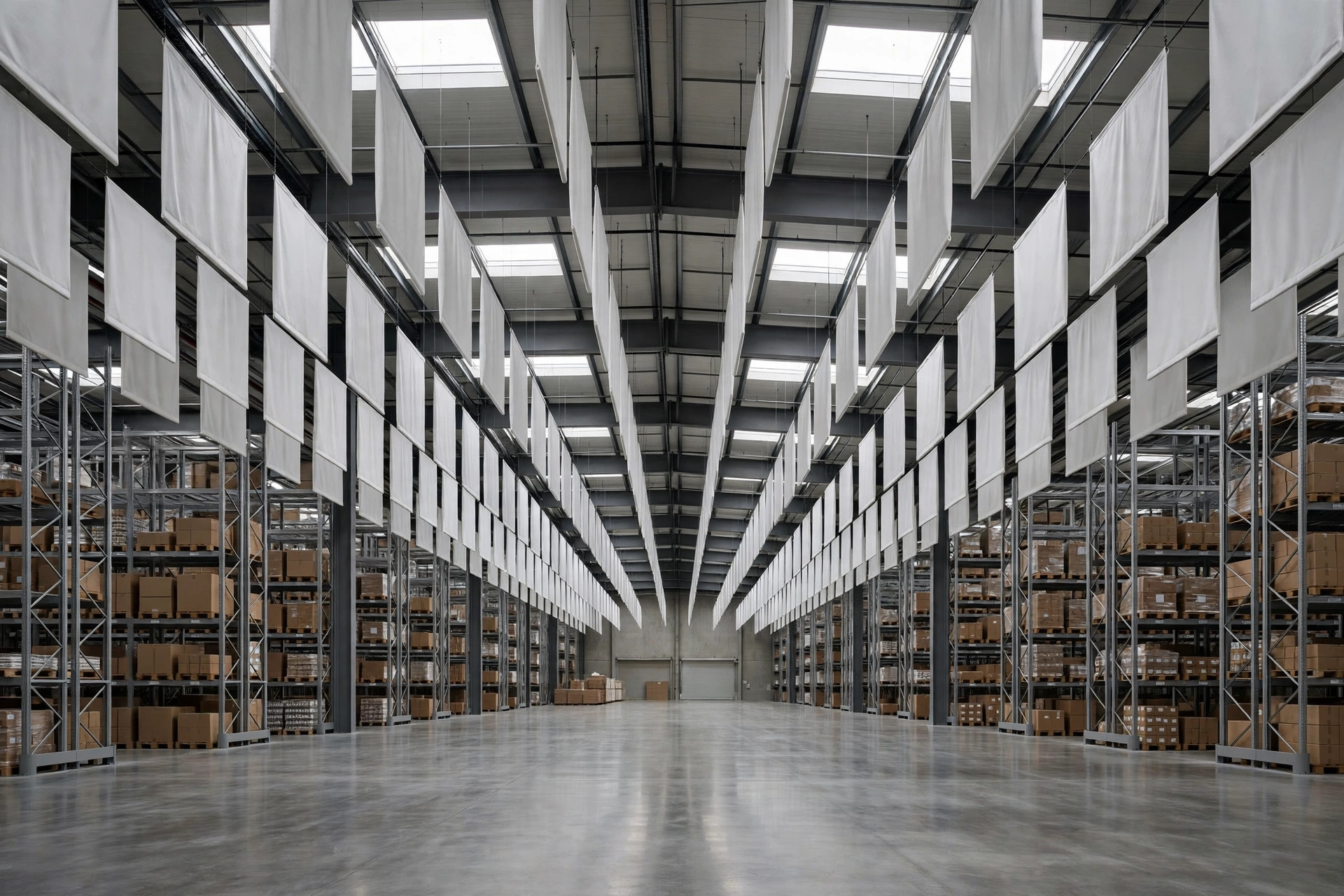
Absorptive baffles and wall panels. This is usually the highest value step. Hanging acoustic baffles from the ceiling, or mounting fabric wrapped panels on the walls, soaks up the reverberant energy that makes the whole building ring. In tall warehouses, suspended baffles are especially effective because they treat the large open volume without touching the floor or the racking. This single change often produces the most noticeable difference in speech clarity and overall loudness.
Barriers between noise and people. Where a loud operation sits next to a quiet one, such as a packing station beside a compressor room, a barrier can help. Heavy flexible barriers like mass loaded vinyl, or modular partition systems, block sound from traveling across the space. Barriers do not absorb sound, they block it, so they pair well with the absorption above.
Vibration isolation. Some warehouse noise is not airborne at all. Machinery bolted straight to the floor or a mezzanine can shake the structure and radiate noise elsewhere in the building. Anti-vibration pads and isolation mounts under the equipment break that path. It is a small line item that solves problems absorption never can.
Layout and operational changes. Sometimes the cheapest treatment is moving things around: shifting the loudest equipment to one end of the building, turning a conveyor so the noisy drive faces a wall, or adjusting the hours of the loudest operations. A consultant reviewing the site will usually spot one or two of these immediately.
What not to do
Do not cover the walls with thin foam and expect a transformation. Thin decorative foam absorbs a little high frequency energy and almost nothing else, which barely dents a warehouse problem. And do not treat before you measure. Two warehouses of the same size can have completely different noise profiles, and the wrong treatment in the right quantity is still the wrong treatment.
If you run a facility in the San Diego area
We work with warehouses, distribution centers, and light industrial facilities across San Diego County and Escondido on exactly this kind of problem: on-site noise surveys, treatment plans that target the real sources, and supply of the acoustic products that fit the plan, from ceiling baffles to barrier materials. Request a quote through our proposal form, or call (716) 330-1147 and tell us what your building sounds like. We will help you figure out what it actually needs.