
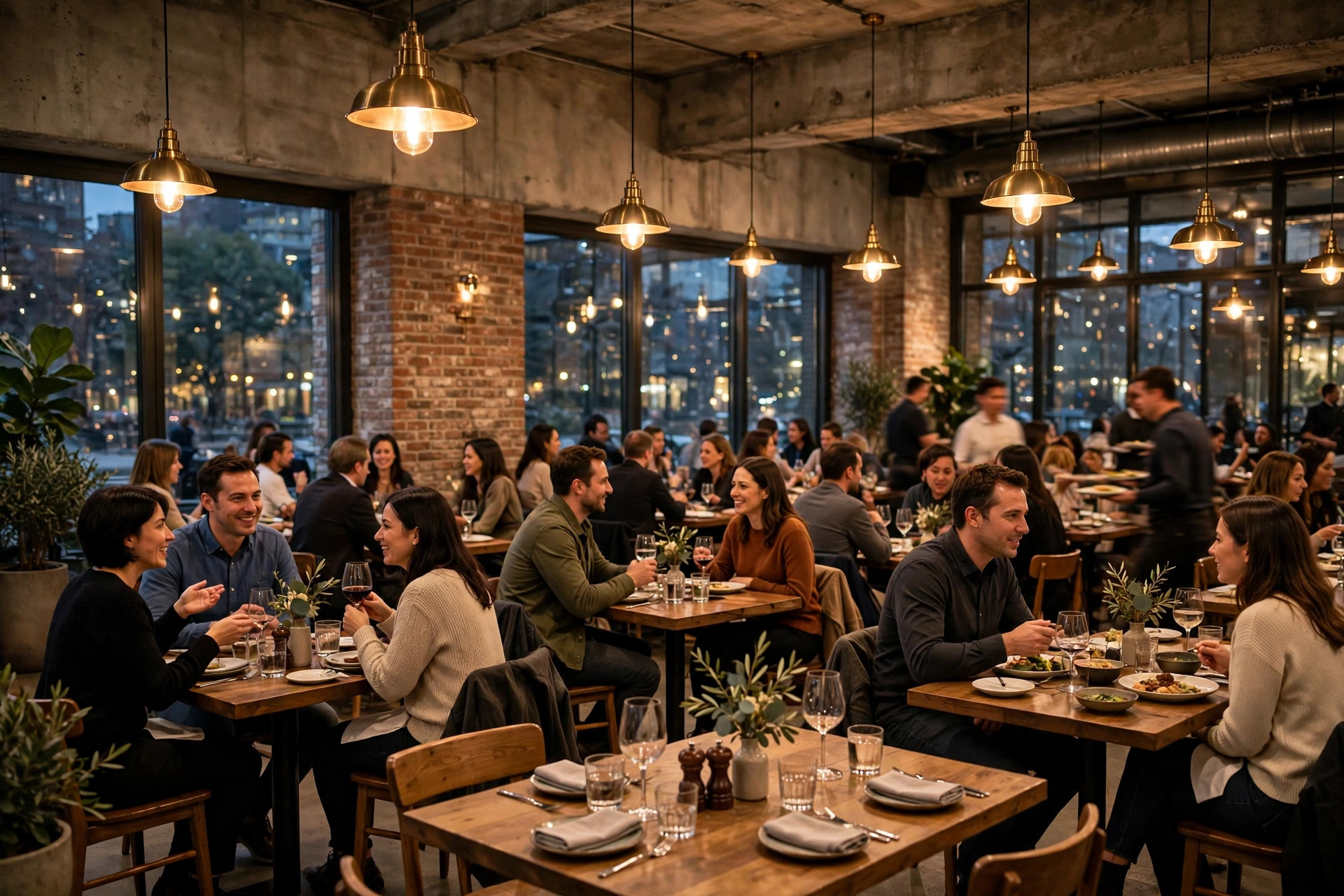
Noise is one of the most common complaints diners have about restaurants. Surveys of restaurant reviews have found it right near the top of the gripe list, ahead of slow service in some cases. And it is not hard to see why. You plan a nice dinner out, sit down, and spend the whole evening leaning across the table saying "what?" A meal you wanted to savor turns into a shouting match.
Where the noise really comes from
A common misconception is that a loud restaurant has one big problem, like a blaring sound system. In practice it is usually a pileup of smaller ones. A busy dining room is full of sound sources: dozens of conversations at once, chairs scraping, plates clattering, an open kitchen firing behind the pass, the espresso machine, background music turned up to compete with it all.
Hard surfaces do the rest. Modern restaurant design loves the materials that sound loves to bounce off: concrete floors, exposed brick, glass storefronts, high ceilings with ductwork, bare wood tables. Every one of those surfaces reflects sound instead of absorbing it, so noise does not die away. It builds. Guests raise their voices to be heard over the room, the room gets louder, guests raise their voices more. Acousticians call it the Lombard effect. You probably just call it a Friday night.
What actually fixes a loud dining room
The good news is that this is an absorption problem, and absorption is the easier, more affordable half of noise control. You do not need to rebuild the room. You need to give sound somewhere to go.
Start with the ceiling. It is the largest uninterrupted surface in most dining rooms, and it is usually the highest-impact fix. Suspended acoustic baffles or ceiling rafts hang above head height, where noise collects, without taking any floor space or seating away. They work especially well in rooms with high or exposed ceilings, which are the rooms that tend to be loudest.
Wall panels come next. Fabric-wrapped acoustic panels absorb the reflections that bounce between parallel walls and keep conversations bleeding from table to table. Today they can be printed with custom artwork, wrapped in fabric that matches the interior, or shaped into design features, so they do not have to look like an afterthought in an office. Done right, guests see a decorated wall. The room feels calmer.
Furnishing choices matter too, and they are the cheapest lever you have. Booths with high backs are acoustic partitions and absorbers in one. Upholstered chairs, carpet or rug runners in high-traffic zones, heavier tablecloths, and lined drapery all take the edge off. None of these is a fix by itself, but they stack up.
And look at the sound system. Background music that is fine at half capacity becomes a wall of sound at full capacity. Reviewing speaker placement and volume levels, and keeping music below the point where it makes guests raise their voices, is free to try and often makes an immediate difference.
What does not work as well as people hope
A few popular fixes deserve a reality check. Strictly speaking, soundproofing is about blocking sound from getting in or out, which is rarely the actual problem inside a dining room. Thin foam panels mainly absorb high frequencies and leave the low rumble of a crowded room untouched. And there is no single product that fixes a loud restaurant; it is almost always a combination of the ceiling, the walls, and the furnishings working together.
Watch out on the other side, too. A completely dead dining room feels awkward, because guests become self-conscious that everyone can hear their conversation. The goal is not silence. It is a room with enough energy to feel alive and enough absorption to let people talk across a table without shouting.
When to bring in a professional
If you have tried the obvious fixes and the room is still loud, or you are designing a new restaurant and want the acoustics right before you open, that is when professional help pays for itself. An acoustical consultant can measure the room and recommend the combination of treatments that will actually move the needle, rather than a series of guesses.
A noisy dining room costs you repeat guests. The fix is rarely dramatic. It is just a room that finally gives sound somewhere to go.
If your dining room is louder than you want it to be, Silentical can help. We assess restaurant and hospitality spaces and supply the acoustic panels and materials to fix them. Send photos and dimensions through our quote request flow, or call (716) 330-1147 to talk through what your space needs.