
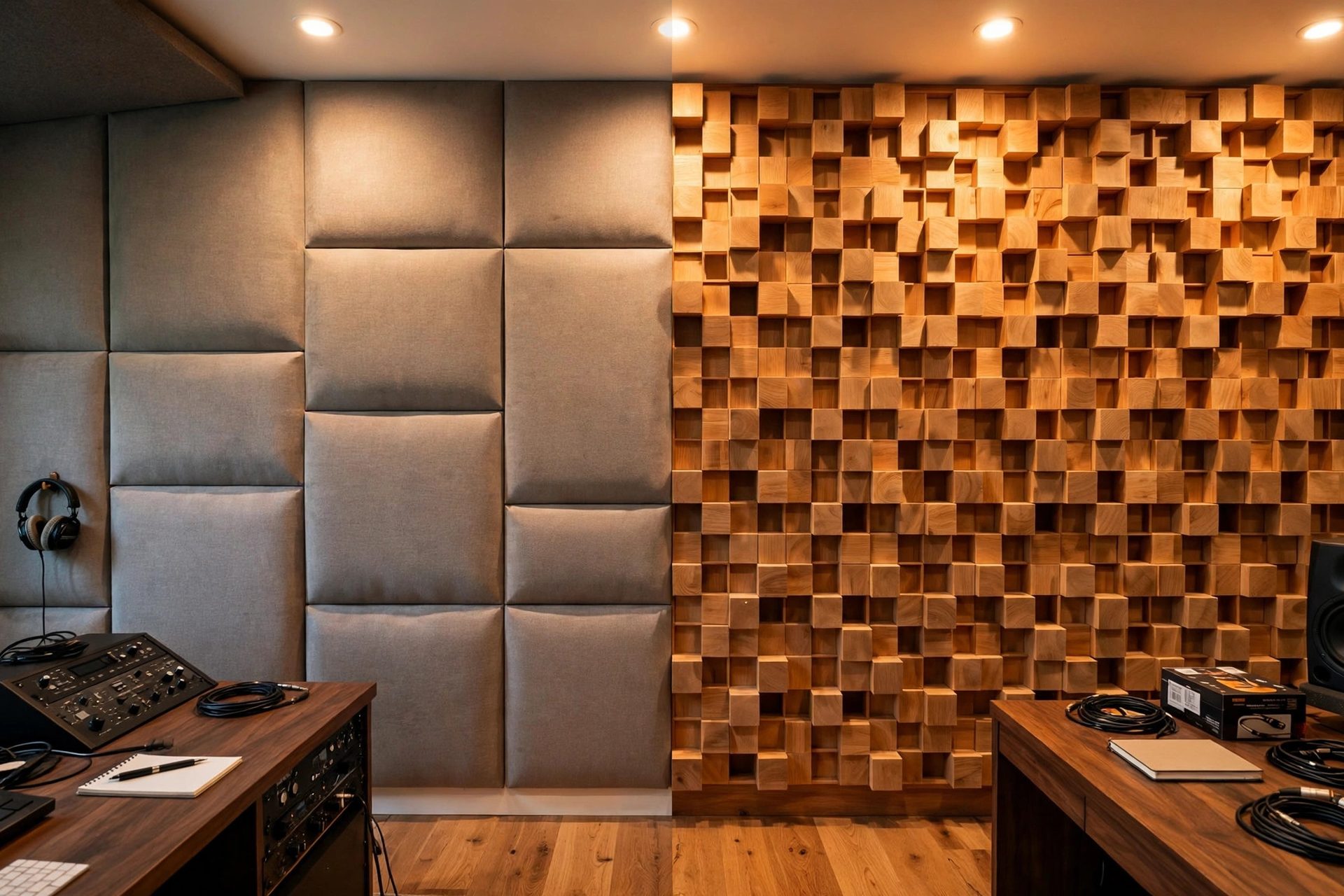
Walk into almost any home studio, podcast booth, or office conference room and you will see panels on the walls. Some are soft fabric rectangles. Some are wooden grids with blocks at different depths. They look like they do the same job, but they do the exact opposite job, and mixing them up is the most common mistake we see in DIY acoustic treatment.
Absorbers soak sound up
An acoustic panel, sometimes called an absorber, is built to convert sound energy into a tiny amount of heat inside the panel material. Fabric wrapped panels, foam panels, and mineral wool panels all work this way. When sound hits one, less of it bounces back into the room.
Use absorbers when a room is too echoey and too loud. If you clap in a bare concrete warehouse or a new office with glass walls and hear that sharp ringing repeat, absorption is what brings it down. Absorbers shorten reverberation time, which is why speech gets clearer and music recordings stop sounding like they were made in a tunnel.
The places absorbers earn their keep: first reflection points beside a listening position, ceilings over conference tables, walls in restaurants and gyms, and just about any small room where slap echo is the main problem. Small rooms are almost always absorption-first, because diffusers need distance from the listener to work properly, and small rooms simply do not have it.
One warning: you can overdo it. A room packed wall to wall with absorbers sounds dead and lifeless, and people find that uncomfortable. Absorption is a tool, not a goal.
Diffusers scatter sound
A diffuser does not remove sound energy. It takes sound hitting it and scatters it in many directions instead of bouncing straight back. The classic example is a quadratic residue diffuser, those wooden panels with square blocks at different depths. Each depth delays the reflection a little differently, so the sound spreads evenly through the room instead of hitting your ears as one harsh reflection.
Use diffusers when the room already sounds under control but flat or boxy. They keep the room sounding alive while breaking up problem reflections. Behind a listening position in a mixing room, on the back wall of a small concert hall, in a high-end home theater: that is diffuser territory. They are the reason a treated studio still sounds spacious instead of sounding like a closet.
Diffusers mostly work in the mid and high frequencies. They will not fix bass buildup in corners, and they will not fix a room with a five-second echo. They are a finishing touch for a room that is already mostly treated.
The rule of thumb
Absorption fixes loud and echoey. Diffusion fixes flat and boxy. Most rooms that sound good use both: absorbers to control the reflections that smear detail, diffusers to keep the remaining sound field smooth and natural instead of dead.
If your room has bare hard surfaces and you can hear your own echo, start with absorbers. If you have already treated the room and it sounds lifeless, that is when diffusers come in.
Getting it right for your room
The catch is that every room is different. Ceiling height, wall angles, how the room is used, and where people sit all change what goes where. Guessing usually means buying twice: once for what the internet suggested, and once for what actually worked.
This is what Silentical does every day. Our catalog carries both sides of the equation, including fabric wrapped acoustic panels and quadratic residue diffusers, and our consulting team can measure your space and design a treatment plan that matches it. Browse the products, add what you need to a quote cart, or talk to us first and we will point you at the right combination.
Call us at (716) 330-1147 or start a quote online. We would rather sell you the right ten panels than the wrong fifty.