
You can do everything right and still hear everything. Double layered drywall, insulation in the wall cavity, even mass loaded vinyl behind the wall surface, and yet the neighbor's conversation comes through clear as day. In most cases like that, the culprit is not the wall at all. It is the door.
Sound takes the easiest path, and that path is almost always the door
A solid wall works as a single heavy barrier. Sound has to push through its full mass to reach the other side, and mass resists. A door is different. Even a heavy door sits inside a frame with small gaps around it: under the bottom, along the sides, at the latch. To sound, a quarter inch gap is not a small detail. It is an open window. Airborne sound travels through air, and any place air passes, sound follows with it. A standard interior door with gaps around it can undo most of the work done by an otherwise well built wall.
This is why acousticians treat the door and the wall as one system. A wall only performs as well as its weakest part, and the door is the weakest part in nearly every room. Improving the wall while ignoring the door is like sealing a boat and leaving one plug out.
What actually makes a door block sound
Real sound blocking at a door comes down to three things: mass, sealing, and decoupling. Each one matters, and none of them work well alone.
Mass. Heavier doors block more sound. A hollow core door, which is mostly air inside, does very little to stop noise. A solid core door has real weight and performs noticeably better. This is the simplest upgrade in soundproofing, and it is also the one people skip most often because a door "looks" the same either way.
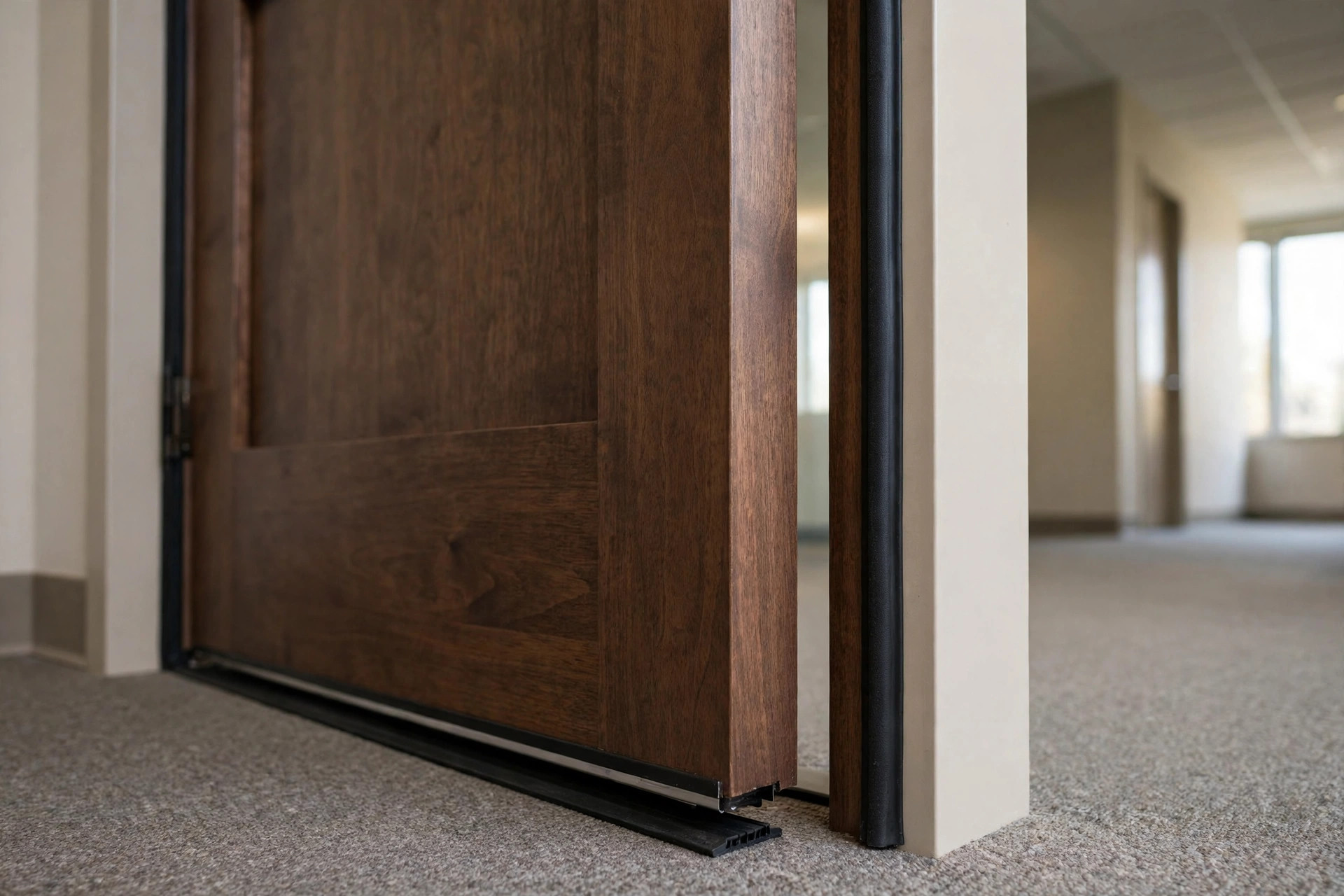
Sealing. The perimeter gap is where most sound leaks. Proper acoustic sealing means compressible gaskets around the full frame and an automatic drop down seal at the bottom that closes the gap when the door shuts. Without a bottom seal, everything else is cosmetic. Many people add weatherstripping and call it done, but ordinary weatherstripping compresses permanently over time and leaves leaks. Acoustic door seals are made to hold their seal through years of daily use.
Decoupling. In serious installations, the door slab itself can be built as two faces separated by a damping layer, so vibration does not travel straight through. This is the same principle behind staggered wall construction, applied to the door.
Ratings are a guide, not a guarantee
Doors sold for sound control often carry an STC rating, the same sound transmission class used for walls. A higher number means more sound blocked. Ratings are useful for comparing products, but they describe the door tested in a lab, perfectly installed and fully sealed. In a real building, the installed result depends on the frame, the seals, and the surrounding wall. An expensive acoustic door set into a thin partition with no bottom seal will perform like an ordinary door.
When a door kit is enough, and when you need a real acoustic door
Not every situation needs a purpose built acoustic door assembly. For a home office where the goal is simply to take the edge off hallway noise, upgrading to a solid core door plus quality perimeter seals and a drop bottom can make a meaningful difference. For a recording room, a therapy office, a classroom, or any space where privacy is the point, a full acoustic door system, specified together with the wall construction, is the right call. The decision comes down to what is on the other side of the door and how much sound you can afford to let through.
A good rule of thumb: if the noise problem existed before you looked at the door, the door was probably part of the problem all along. Fix it as part of a plan, not as an afterthought.
If a noisy door is your problem, start with the whole picture
Door upgrades work best when someone looks at the room as a system: the wall construction, the frame, the seals, and what the space is used for. We supply acoustic doors and sealing systems through our catalog, and our consulting team handles the assessment and specification side, from a single office door to full facility plans. Request a quote through our proposal form, or call (716) 330-1147 and describe what you are hearing through the door. We will help you figure out what it actually needs.