
If you are opening a restaurant with live music, building a new apartment complex near a highway, or starting a warehouse with trucks coming and going at all hours, there is a good chance someone will ask you for a noise study before you get your permits. It sounds like a formality, but it is one of the most practical documents in a development project.
A noise study is a measurement-backed look at how sound moves around a site
At its core, a noise study is a technical assessment performed by an acoustical consultant. It answers two questions: how loud is it at and around your site right now, and how loud will it be once your project is operating?
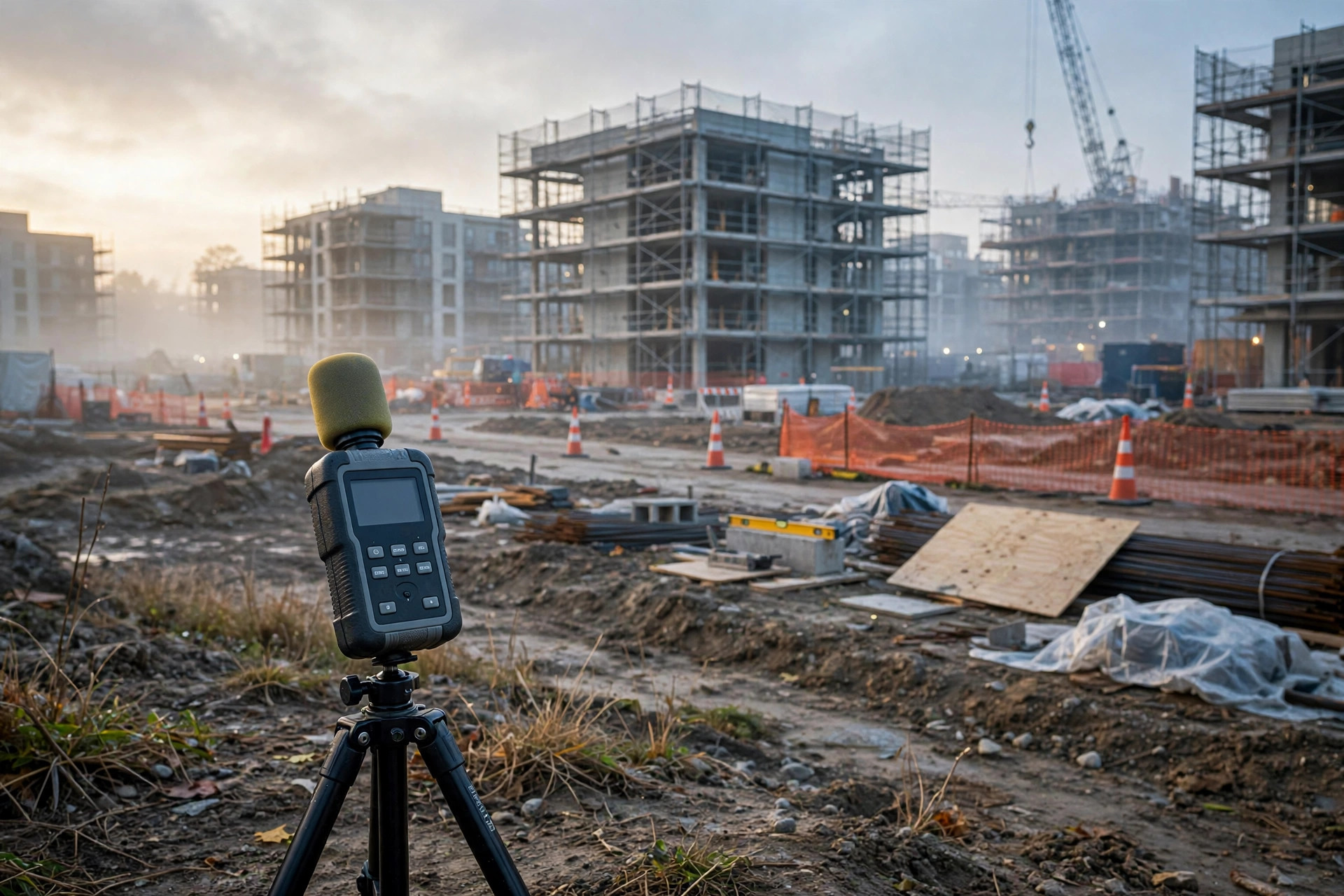
The “right now” part is called a baseline survey. A consultant visits the site with professional sound level meters and records the existing sound environment over a representative period, capturing rush hour, quiet night hours, and the loudest moments of the week. Any claim about your project’s impact only makes sense against that background.
The “what will it be” part is prediction. Using acoustic modeling software, the consultant builds a model of the site with your buildings, equipment, traffic, and any other noise sources, then calculates how sound will travel to the nearest homes, schools, or other sensitive receivers. Good modeling accounts for distance, barriers, building reflections, and ground effects, so the result is far more reliable than a guess.
When a noise study is typically required
Noise studies are most often requested by a city or county as part of the planning process. Here are the situations where they come up most often:
New development near noise sources. If you are building homes, a school, or a daycare near a freeway, a railway, or an airport, the planning department will want to know whether future occupants will be exposed to acceptable noise levels, and what the building design needs to do about it.
New noise-generating businesses. Restaurants with patios, bars with music, event venues, car washes, loading docks, and drive-throughs can all trigger a study, especially when neighbors are close by.
Industrial and construction projects. Manufacturing plants, recycling facilities, and large construction sites usually need to show that their operations will stay within the local noise limits at the property line.
Responding to complaints. Sometimes a study is needed after the fact, when neighbors have complained and the city wants a professional measurement to settle the question.
If you are in the San Diego area, the request often comes with a conditional use permit or site development application. Finding out early is usually an advantage, since acoustic measures tend to be simpler to design into a project than to add after construction.
What happens during the study
A typical noise study follows a straightforward sequence. First, the consultant reviews your project plans and the applicable local noise rules to understand exactly what needs to be demonstrated. Then comes the on-site baseline survey: sound level meters are placed at key locations around the site and left to record for an appropriate period.
Next, the consultant models the future condition: your facility, your equipment, your traffic, your hours of operation. If the predicted levels fall within the applicable limits, the report documents those results for the planning record. If not, the report recommends mitigation measures: repositioning equipment, adding barriers or enclosures, adjusting hours, or upgrading the building envelope. The point is never just to flag a problem; it is to give you a practical path to approval.
Finally, all of this goes into a formal report: the methodology, the measured data, the model assumptions, the results, and the recommendations. That report goes to the planning department as part of your project’s record.
A noise study protects the project, not just the neighbors
It is easy to see a noise study as another hoop to jump through. But developers who treat it that way often end up redesigning at the last minute, which costs far more than the study itself. A noise study done early tells you what is feasible before you commit to a layout, and it gives you defensible data if a neighbor or a council member raises a concern later.
Not sure whether your project needs one?
Planning a project in or around Escondido or greater San Diego where noise might come up? Talk to an acoustical consultant before the city asks. We perform baseline noise surveys, predictive noise modeling, and full noise impact assessments for development applications, permits, and complaint response. Request a quote through our proposal form, or call (716) 330-1147 and we will help you figure out what your project needs.