
A neighbor complains about the pile driver shaking their walls. A city planner conditions your permit on a noise monitoring plan. A hospital sits fifty feet from your excavation. This is the moment most builders discover that construction noise and vibration monitoring is a real discipline, with real equipment, and that getting it wrong can stop a project cold.
Here is what the work actually looks like, step by step, and why it matters long before the first complaint lands.
It starts before construction does: the baseline survey
Before any machine rolls in, an acoustical consultant measures the existing noise and vibration at the site and the sensitive spots nearby: homes, schools, clinics, historic buildings. This is called a baseline survey, and it is the reference line for everything that follows.
The baseline matters for two reasons. First, it tells you what limits are reasonable. A site next to a freeway already lives with high background noise, so a strict quiet-site limit would be impossible to meet. Second, it protects the builder. When a neighbor claims the project cracked their foundation, the pre-construction survey is the evidence that separates real damage from coincidence. Without it, every complaint becomes an argument.
During construction: continuous monitoring
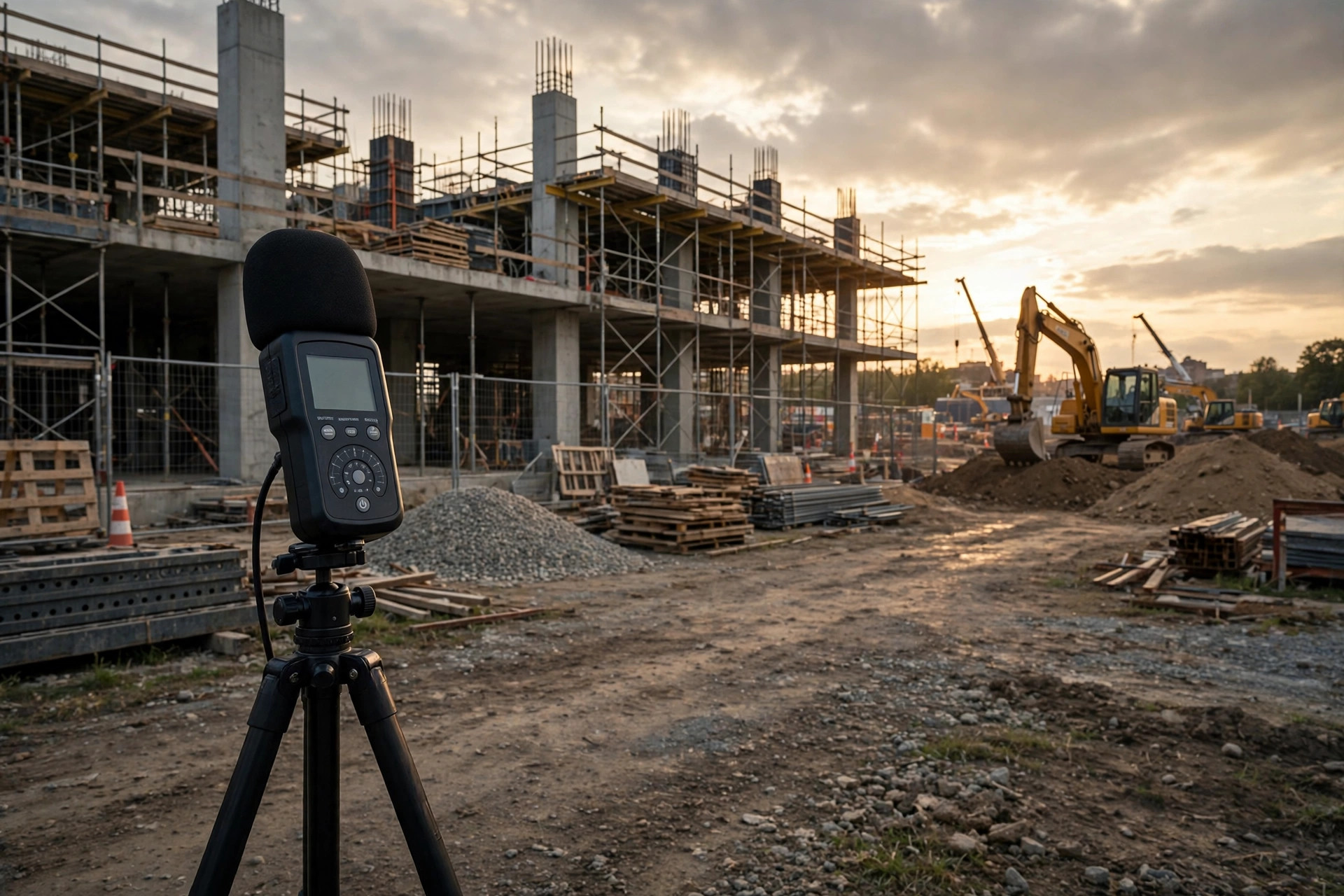
This is the part most people picture. Sound level meters and vibration sensors get installed at the property line or at the nearest sensitive buildings, and they run for the duration of the loud phases of the project.
There are two flavors. Attended monitoring means a consultant is on site with handheld equipment during specific operations, taking readings and noting what was happening when each one was taken. Unattended monitoring means automated stations that log continuously, day and night, with remote access so alerts can be checked in real time.
The metrics are straightforward in concept. For noise, the running average sound level over each period tells you the general picture, while peak events capture the loud single hits. For vibration, the key measurement is peak particle velocity, essentially how fast the ground moves at the building foundation, which is the best predictor of whether vibration is approaching levels that risk cosmetic damage to plaster and masonry.
When a threshold is approached, the system alerts the project team and the work can be adjusted: swap a vibratory roller for a static one, slow the pile driving sequence, restrict the loudest work to the hours the community agreed to. Monitoring is not about documenting a violation after the fact. Its value is the early warning that prevents one.
Why builders ask for it voluntarily
A lot of monitoring is required by permit conditions, especially near homes, hospitals, and older buildings. But builders also commission it on their own, because the alternative is worse. A single damage claim for a cracked foundation or a plaster wall can cost more than the entire monitoring program, and documented measurements showing the project stayed within limits are the strongest possible defense. Transparent monitoring, shared data, posted schedules, a community contact line, also calms neighbors down in a way no amount of reassurance does. People accept noise they understand and expect. They do not accept noise that surprises them.
What a good monitoring plan includes
Whether required or voluntary, the plan should spell out the equipment and where it sits, the limits that trigger action and what the action is, who gets alerted and how quickly, the reporting cadence to the city or the client, and a complaints protocol. The weakest monitoring programs fail not on equipment but on response: nobody watching the alerts, nobody authorized to change the work, data sitting in a logger that nobody downloads.
The part people skip, and regret
The baseline survey. Almost every expensive noise or vibration dispute we have seen comes down to the same missing piece: nobody measured the starting point. With a baseline, a builder can say, with data, that conditions did not change. Without one, every complaint is plausible, and plausible complaints become settlements.
If you are planning construction near anything sensitive, and especially if your permit hints at noise or vibration conditions, the cheapest time to talk to an acoustical consultant is now, before the equipment is mobilized. Silentical's construction noise and vibration monitoring covers the full sequence: baseline surveys, predictive modeling, continuous on-site monitoring with real time alerts, and the reporting that keeps cities and neighbors satisfied. We work with builders across San Diego County, including Escondido and the surrounding North County cities.
Call us at (716) 330-1147 or request a proposal online. Measured data turns a noise dispute into a manageable project, and a complaint into a conversation.