
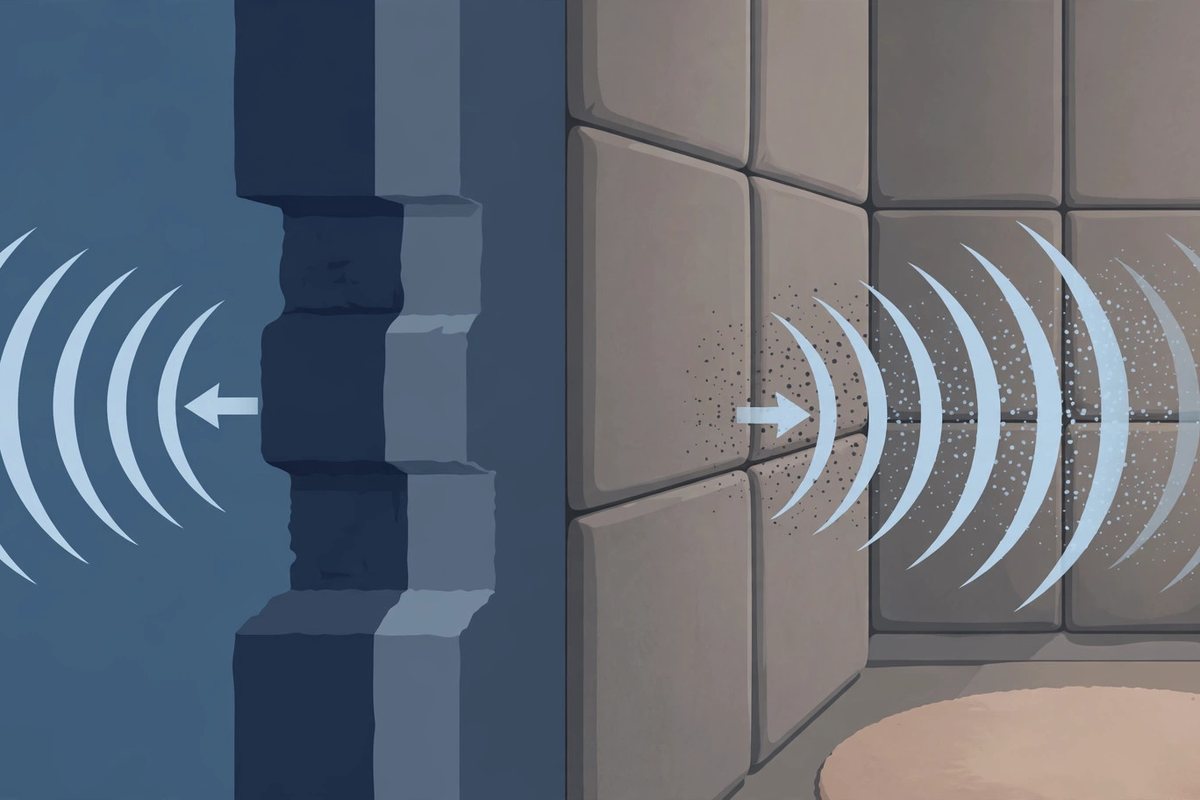
Ask five people what “soundproofing” means and you will get five answers, and most of them are actually talking about two different things. There is soundproofing, which keeps sound from getting in or out of a room. And there is acoustic treatment, which changes how the room sounds from the inside. People mix them up constantly, and that is how rooms end up full of panels while the neighbor noise comes straight through the wall.
Soundproofing keeps sound in its place
Soundproofing is about isolation. It stops your voice from reaching the neighbor’s apartment, and it stops their television from reaching you. It works by blocking the paths sound travels along, and it follows a few stubborn rules.
The biggest rule is mass. Heavy things block sound better than light things. That is why a concrete wall does a better job than a thin drywall partition. The second rule is airtightness. Sound is carried by air pressure, so any gap, a door undercut, an outlet box, a pipe penetration, is a leak that weakens everything around it. The third rule is decoupling: keeping one surface from passing vibration straight into the next one, like two walls that stand apart instead of sharing a frame.
Notice what is not on that list: foam, fabric panels, blankets on the wall. None of those stop sound from traveling through a wall. They are doing a different job entirely.
Acoustic treatment makes the room itself sound better
Acoustic treatment is about what happens to sound inside a room. A bare room with hard floors and drywall is a playground for reflections. Sound bounces off every surface and arrives at your ears dozens of times, which is why an empty apartment sounds echoey and why a conference room can make every voice mush together.
Treatment tames those reflections. Absorbers, like fiberglass or mineral wool panels, soak up sound energy and shorten the echo. Diffusers scatter sound so it spreads evenly instead of piling up in hot spots. Bass traps, thick absorbers placed where low frequencies collect, keep bass from booming in the corners.
None of this stops your neighbor from hearing you. Panels on the wall do not keep sound from passing through the wall. They change the character of the room you are standing in. That is valuable, just not for the problem most people buy them to solve.
Why mixing them up costs money
This is the expensive mistake, and it happens every week. Someone hears the neighbors through a shared wall, buys a cart full of acoustic panels, glues them up, and nothing changes. The panels were working as designed. They just were never going to fix that problem, because the problem was isolation and the product was treatment.
So before you spend anything, ask one question. Is the problem sound traveling through a wall, floor, or ceiling? Or is the problem the way sound behaves inside the room? Traveling sound needs soundproofing. Echo, muddiness, and boomy bass need treatment.
The right order of operations
When a room needs both, isolation comes first. There is a practical reason. Treatment fine-tunes the room, and you cannot fine-tune a room that is still leaking street noise through the windows. Get the box quiet first, then shape the sound inside it.
In practice: seal the air leaks, add mass where it counts, and deal with the weakest surface, which is usually the door or the window. Then add absorbers and diffusers.
There is also a money reason. Isolation work gets dramatically cheaper while the walls are open. Panels can go on the wall at any time.
A quick way to tell what you have
Stand in the room and clap once. If the clap rings and lingers, you have a treatment problem: too many reflections, not enough absorption. If you can follow a conversation through the wall next door, you have an isolation problem: sound is traveling through the structure.
Many rooms have both, and that is fine. The trick is fixing the right one first. And if you are ever unsure which problem you are hearing, that is exactly the question a consultation answers before the first dollar gets spent.
Start with the right question
Soundproofing and acoustic treatment are not competitors. They are two halves of quiet, and they solve different problems with different tools.
If you are planning a studio, a home office, a restaurant, or any room where noise is part of the design, Silentical works on both sides of this. Send the details through the quote form for a proposal, or call (716) 330-1147 and tell us what you are hearing. We will tell you which problem it is.