
Mass loaded vinyl, usually called MLV, shows up in almost every serious soundproofing conversation. It also shows up in a lot of conversations where it does not belong. This is the straight version: what it is, what it does, what it does not do, and where it is worth the trouble.
It is heavy, thin, and limp on purpose
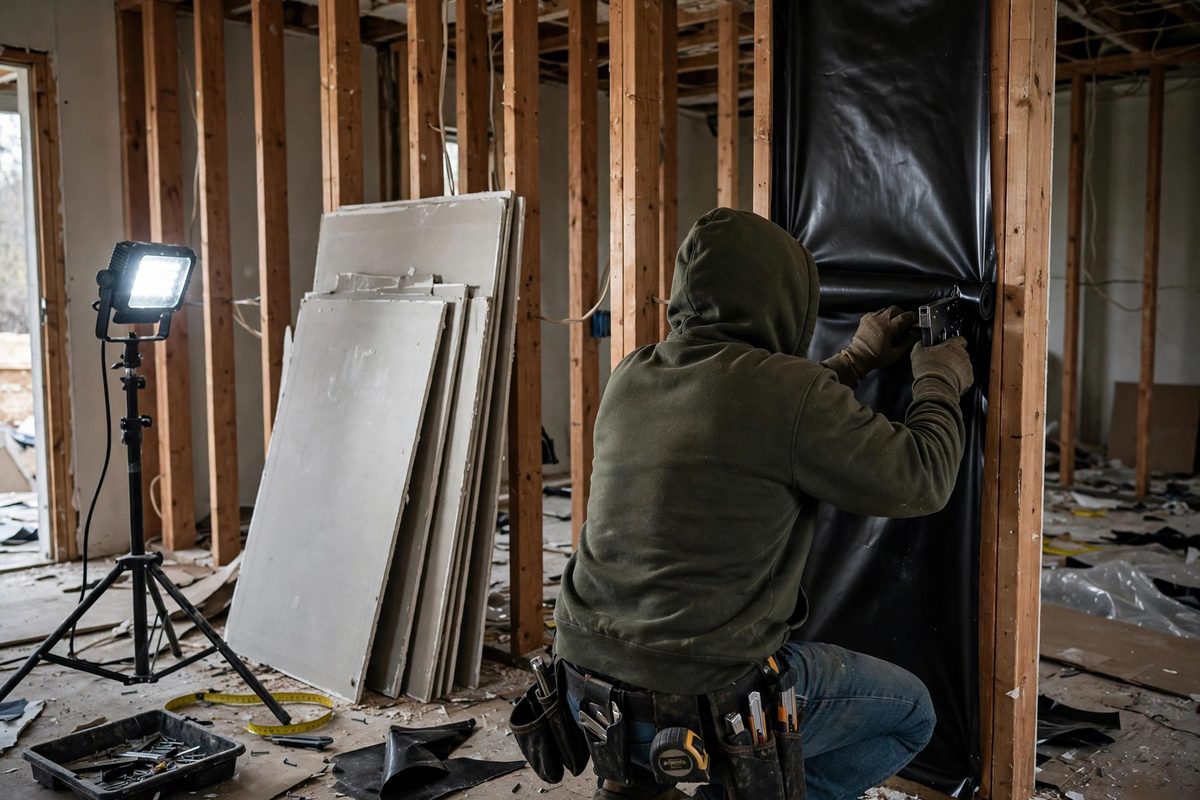
MLV is a sheet material made from vinyl that has been loaded with mineral weight until it is dense enough to act as a sound barrier. It feels like a thick, flexible rubber mat. It cuts with a utility knife, hangs from walls and ceilings, and goes under flooring.
Its one big property is mass. Sound moves through a wall by vibrating it. A heavier wall vibrates less. MLV adds meaningful mass without much thickness, which is the whole point.
The "limp" part matters too. A rigid heavy panel can pick up vibration and pass it along. A limp sheet does not ring the way a stiff panel can. It just sits there, heavy and quiet.
What it does not do
MLV is a barrier, not an absorber. Hanging it on a finished wall will do very little to change how a room sounds. It will not reduce echo, it will not calm the slap of reflections between parallel walls, and it will not make a noisy room feel calmer to be in.
This is where most of the disappointment comes from. People buy MLV expecting the room to sound better. That is an absorption job. If your problem is that the room sounds harsh and echoey, you want acoustic panels. If your problem is that the neighbor hears the television, that is where MLV enters the picture.
Where it earns its place
MLV works best inside an assembly, paired with the other two elements of real sound isolation: sealing and decoupling.
The classic home setup is inside a wall. MLV goes between the studs and the drywall, or between two layers of drywall. The drywall gives structure and more mass, the MLV adds mass without much thickness, and acoustic sealant closes the gaps at edges and around outlets where sound slips through. None of these pieces works well alone. Together they are a system.
Under flooring it serves a similar purpose. Footsteps travel through a floor as vibration. A layer of MLV under the finished floor adds mass and damping that reduces how much of that vibration reaches the room below. It does not eliminate impact noise by itself, but as part of a floor assembly it is one of the thinner ways to gain real improvement.
The common thread is that MLV belongs inside the construction, doing the quiet work of adding mass where thickness is limited. That is what it is designed for.
What to check before you buy any
Three checks decide whether MLV is right for your project.
First, name the problem. If sound needs to stay inside a room, like a home theater or a music practice room, you need isolation, and MLV can be part of it. If the room just sounds bad to be in, you need absorption instead.
Second, check the weak links. A wall reinforced with MLV still leaks sound through a hollow door, unsealed outlets, and shared duct runs. Sound finds the easiest path. Fix the gaps at the same time or the reinforced wall will be the strong link in a chain that still breaks.
Third, think about access. MLV goes inside the assembly, which means the wall or ceiling has to be open, or it has to be openable. If opening the wall is off the table, the honest options are surface mounted barrier systems or accepting the wall as it is and treating the other weak links.
The bottom line
Mass loaded vinyl is a legitimate sound barrier. It adds mass where thickness is limited, it is flexible and easy to work with, and it belongs in walls, floors, and ceilings as part of a complete isolation assembly. It is not an echo fix, not a room treatment, and not a product that does anything on its own.
If you are planning a home theater, a studio, a shared wall, or a floor assembly, and you are not sure which combination of barrier, sealing, and decoupling your situation calls for, that is exactly the kind of question worth asking before you buy materials. Add products to a quote cart on the site, or request a proposal for a noise assessment. Call (716) 330-1147 and tell us what you are trying to keep in or keep out. We will tell you honestly whether MLV is the right tool for it.