
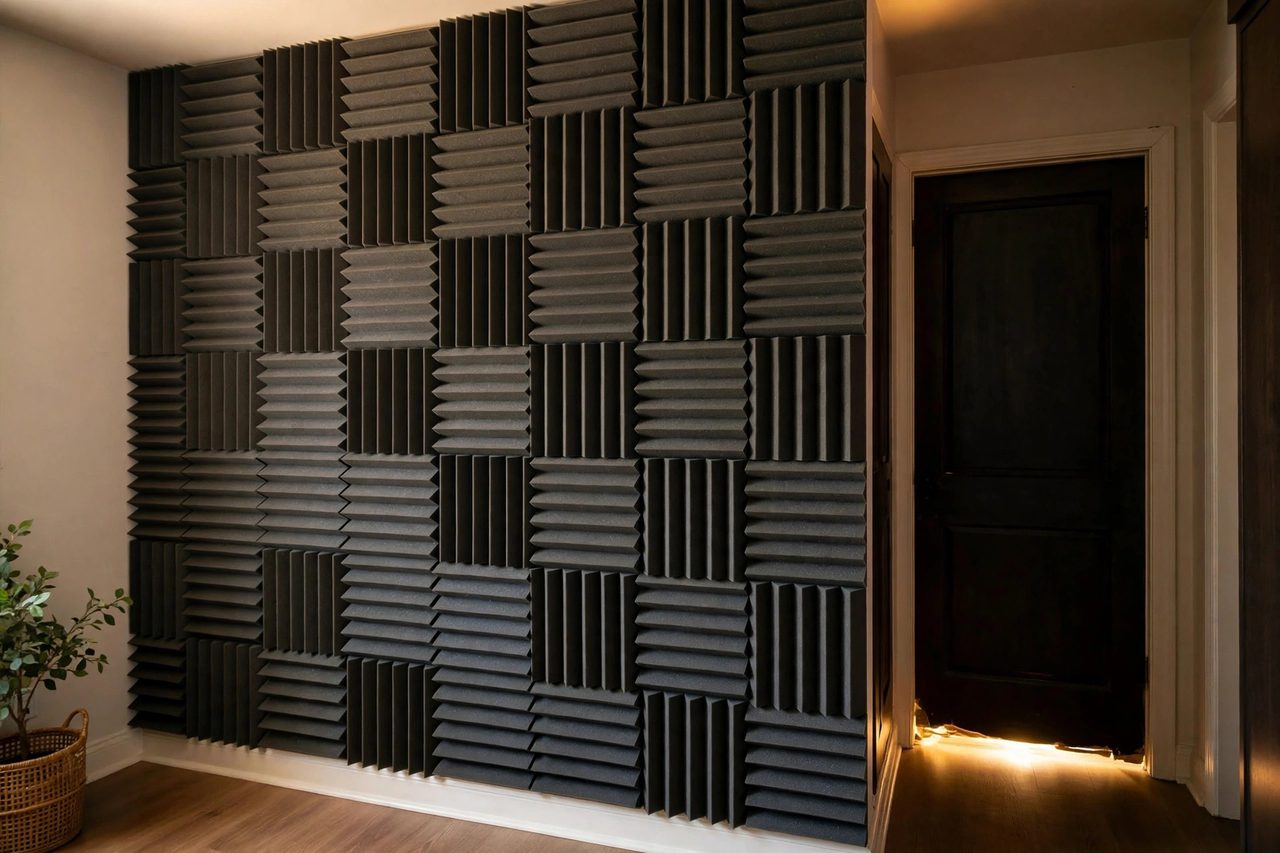
One of the most common acoustic questions we hear is simple: will acoustic foam panels stop sound from getting through my walls? The honest answer is no. Foam changes how a room sounds from the inside. It does almost nothing to stop sound traveling through a wall. Understanding the difference saves people a lot of wasted money.
Two different jobs
Every room acoustic problem falls into one of two categories, and they need completely different fixes.
The first job is acoustic treatment: improving the sound inside the room. Echo on a video call, reverb muddying a recording, a classroom that feels harsh and loud. The sound is already in the room and keeps bouncing off hard surfaces. Soft, porous materials like fabric wrapped panels and acoustic foam absorb those reflections and calm the room down.
The second job is sound isolation: stopping sound from passing in or out. Your neighbor's television. The drum kit next door. Keeping your band rehearsal from reaching the whole street. The sound is on the other side of the wall, and you want it to stay there. This job is about blocking, and blocking is a different science entirely.
Acoustic foam is designed for the first job. Ask it to do the second and it will quietly fail.
Why foam cannot block sound
Sound travels through walls because pressure waves push the wall material into vibrating, and the wall then re-radiates that vibration into the room. To stop that, you need one or more of four things: mass, airtightness, decoupling, and damping.
Foam has almost no mass, and blocking sound is largely a fight against vibration energy. Light materials simply move with the sound wave instead of resisting it. Porous foam is built to let air pass through its cells so sound energy dies inside them as heat. That is exactly what you want for killing echo inside a room, and exactly what makes it useless as a barrier. A material cannot be both highly porous and an effective sound blocker at the same time.
What actually blocks sound
The real playbook is straightforward and every part of it is well established acoustics.
Seal the leaks. Sound behaves a lot like water. It goes through openings, not through the solid parts of the wall. Gaps under doors, unsealed window frames, outlets on shared walls, vents connecting rooms, cable penetrations. Sealing these is the cheapest real improvement in any noise problem and often the biggest one.
Add mass. Heavy walls block more sound than light ones. That is why a second layer of drywall is the most common wall upgrade, and why mass loaded vinyl, a thin dense barrier sheet, often goes between wall layers where losing wall depth matters.
Decouple. When two wall surfaces share the same studs, vibration travels straight through the frame. Resilient channels, isolation clips, or a second independent stud wall break that path. Decoupling is what turns an ordinary wall upgrade into a serious one, especially for low frequency sound like bass and engines.
Treat the weak points. In most rooms the wall is not even the main problem. The hollow interior door, the window, and the vent are. A solid core door with perimeter seals, a secondary interior window with a real air gap, and attention to ductwork often matter more than anything done to the wall itself.
So where does foam belong?
Foam belongs in the finished, sealed room. Once the blocking is handled, treatment is what makes the room pleasant. A few fabric wrapped panels or foam at the right spots cut echo and flutter, tighten up recordings, and make video calls sound clean. It is the polish, not the foundation. Do the foundation first and the polish finally pays off.
This is also where people overspend. Panels arrive before anyone has sealed a single gap, and the room sounds no quieter. The fix costs nothing extra: just the right order. Block first, treat second.
How to know which problem you have
Clap your hands once in the middle of the room. If you hear a metallic flutter echo hanging in the air, you have a treatment problem. If the problem only shows up when the neighbor's television turns on or traffic rolls past at night, you have an isolation problem, and foam, fabric, and curtains will not move the needle.
For the isolation side, Silentical stocks the barrier products that actually do this work: door seals and automatic door bottoms, mass loaded vinyl, secondary window options, and the sealing details that tie it all together, all through a quote cart so you buy only what your room needs. And if the source of the noise is unclear, our acoustical consulting team can measure the space and lay out a treatment plan in the right order.
Call us at (716) 330-1147 or start a quote online. Foam has its place. Just make sure that is the place you are fixing.