
The limit is not inside your shop
Most business owners guess wrong about how loud they can be. They stand inside their shop, their restaurant, or their bar, and the music sounds fine. The air conditioning hums, the kitchen clatters, and nobody inside complains. Then a neighbor calls the city, and the owner finds out the limit was never about the inside at all.
In Escondido, the limit is measured at the property line of the neighbor. A sound level meter stands on the neighbor's side of the fence, and the number it shows is the number that counts. Your shop can sound fine to you and still be too loud at the fence, because sound drops off with distance, and the fence is where the city draws the line.
This guide explains the actual limits in plain English: the numbers for homes, shops, and factories, what the numbers measure, when the limits change, and what to do if a neighbor complains. The limits come from the City of Escondido Municipal Code, Article 12, Noise Abatement and Control, Section 17-229, and the numbers for new homes come from the city General Plan. Check the current code before you make a big decision, because codes get updated.
The numbers, in plain English
The city sets the limit by what sits next door, the receiving land use, not by what makes the noise. If a home sits next to your business, the home's limit applies. The limits are one hour average sound levels in dBA, which is the decibel scale weighted for how human ears hear.
A single family home next door gets 50 dBA during the day and 45 dBA at night. Apartment buildings get 55 during the day and 50 at night. A shop or office next door gets 60 during the day and 55 at night. Light industrial neighbors get 70 at any hour, and general industrial neighbors get 75 at any hour.
Two numbers are worth remembering if you run a business near homes. Fifty during the day and 45 at night is the line for the houses around you. A normal conversation is about 60 dBA, so the night limit at the fence is quieter than two people talking. That surprises most owners, and it is the reason music that sounds reasonable inside a bar can be too loud at the fence outside.
New homes have their own standard in the General Plan. A new single family home is normally acceptable up to 60 dB CNEL outside, and the inside of a new home must not exceed 45 dB CNEL. CNEL is a day and night average that adds a penalty for evening and night noise, because noise at night bothers people more. If you are building near homes, or homes are being built near you, that 60 outside and 45 inside pair is the standard the city plans around.
What a decibel limit actually measures
A limit of 50 dBA does not mean the meter may never show 51. The limit is a one hour average, so the meter watches for an hour and averages what it hears. A truck backing up for ten seconds counts less than a steady air conditioner humming for the full hour. A short loud burst and a steady hum are treated differently, and that difference matters when you are trying to fix a problem.
The measurement is taken at the property line of the receiving property, which is the neighbor's side, at a spot where people actually live or work. The meter uses the A weighting network, which is why the unit is dBA. A weighting turns down the very low and very high frequencies that human ears barely hear, so the number matches what a person actually experiences.
That is also why a phone app is not enough for a real answer. A phone can tell you roughly how loud a room is, but a phone is not calibrated, and its microphone is not built for this job. A real measurement uses a calibrated sound level meter on a tripod, at the property line, for the full hour. That is the measurement a city inspector or a consultant relies on. Our guide to phone noise apps explains what a phone can and cannot do.
Day, night, and weekends
Day runs from 7 a.m. to 10 p.m., and night runs from 10 p.m. to 7 a.m. On weekends the day starts later, at 8 a.m., and the night runs to 8 a.m. The night limit is 5 dBA lower than the day limit for homes, shops, and apartment buildings, and industrial limits stay the same around the clock.
The time of day is the most common reason a business gets a complaint. A restaurant patio that is fine at 8 p.m. can be too loud at 10:30 p.m., because the limit dropped by 5 and the music did not. A delivery truck at 6 a.m. counts against the night limit, even though the sun is up. If your business runs near the edges of those hours, the edges are where to look first.
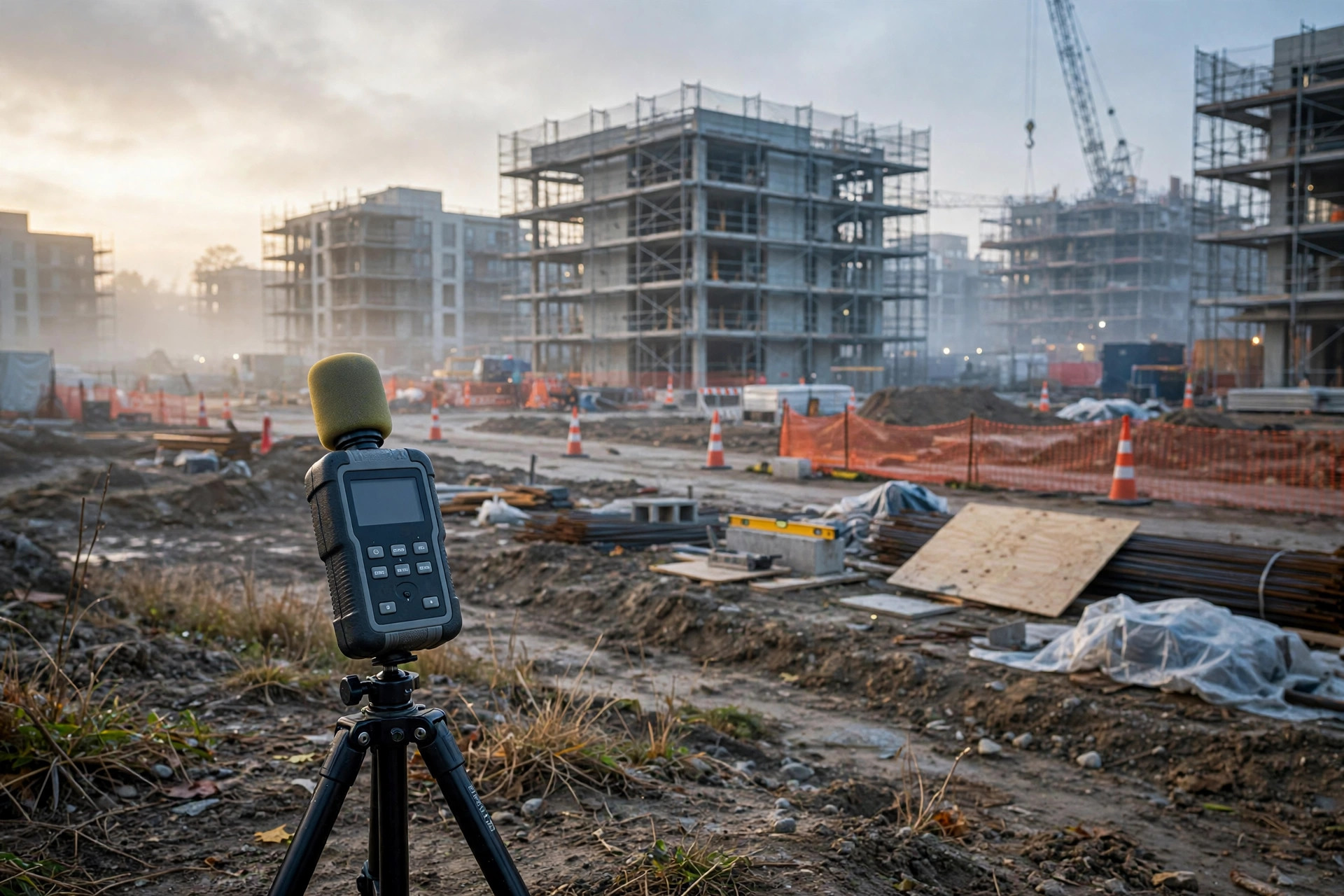
Construction has its own rules in the code. Grading equipment may not exceed a one hour average of 75 dBA at the property line of a home, and job sites must post signs showing the hours of work and the noise limits that apply. If you are planning a build or a remodel near homes, the hours and the equipment matter as much as the design. Our guide to construction noise monitoring explains what actually happens on a real job site.
What counts toward the limit
Everything counts, and the meter does not care what makes the sound. Music from a speaker, a bass note through a wall, an air conditioning unit on the roof, a delivery truck idling at the back door, a forklift beeping, a compressor cycling on and off, all of it adds up at the property line.
Low frequency sound is the one that causes the most complaints, and it is the hardest to fix. Bass from music and the thump of a compressor travel through walls and fences more easily than voices do, and a meter at the fence can show a high number even when the music sounds quiet from the street. If the complaint is about a thump or a hum rather than voices, the fix is usually about the low frequencies, not the volume knob.
Intermittent noise counts too. A truck that comes and goes, a gate that slams, a compactor that runs for two minutes every hour, all of it goes into the average. The one hour average smooths out short bursts, but a burst that repeats all day still pushes the average up.
What happens when a neighbor complains
A complaint usually starts with a call to the city, and the city may send an inspector to measure at the property line. If the measurement is over the limit, the business is asked to fix it. The fix can be a change in hours, a change in equipment, or a physical change to the building, and the city can come back to measure again.
What matters most at this stage is evidence. A business that can show its own measurements, taken properly at the property line, is in a much stronger position than one that can only say the music was not that loud. A noise study documents the levels, finds which source is pushing the number over the line, and shows what fix would bring it back down. Our guide to noise studies explains what a study actually involves, and when you need one.
Do not guess, and do not argue about it from memory. A measurement taken the right way settles the question, and it tells you whether the problem is the music, the air conditioning, the deliveries, or the building itself.
What to do before a complaint arrives
Measure first, before anyone complains. A one hour measurement at the property line, taken while the business runs normally, tells you where you stand against the limit. If you are under, you have a record that proves it. If you are over, you know before the city does, and you can fix it on your schedule instead of theirs.
Then find the path. Sound gets to the fence through the air, through a wall, or through the ground as vibration. Walk the property line and listen. If the music is clear at the fence, the path is the air, and the fix is the speaker direction, the volume, or the hours. If the hum is in the ground, the path is vibration, and the fix is isolation under the equipment. If the sound comes through a wall, the fix is mass and sealing on that wall.
Fix the source before you fix the fence. Turning a speaker away from the neighbor, moving a delivery to daytime, or putting an air conditioner on vibration mounts is cheaper than building a taller wall, and it often does more. A wall helps only if the sound is actually traveling over it, and many business owners build a wall first and find out the sound was coming through the roof vent all along.
When to call for a noise study
Call when a complaint has arrived, when a permit asks for one, when you are opening near homes, or when you have already tried a fix and the complaints kept coming. A study measures the levels the right way, names the source that is actually over the line, and gives you a fix that matches the problem instead of a guess.
If your business sits near homes in Escondido or anywhere in San Diego County, or a neighbor has already mentioned the noise, request a free quote at silentical.com/quote/ or call (716) 330-1147. Tell us what the business does, what sits next door, and what the neighbor hears most, the music, the hum, or the trucks, and we will tell you what a measurement would show and what to do first.