
Sooner or later, every conversation about noise turns into a conversation about decibels. A contractor quotes them. A product page advertises them. A city ordinance sets a legal limit with them. The numbers look as simple as a temperature reading, but they do not behave like one, and that is where people get tripped up. Here is what a decibel really is, how loud common sounds actually are, and how to read the numbers like someone who measures noise for a living.
Decibels in one sentence
A decibel is a unit that expresses how intense a sound is, as a ratio against the faintest sound the average human ear can hear. That faintest sound sits at about 0 dB, the threshold of hearing. The unit is one tenth of a bel, named for Alexander Graham Bell, and in practice everyone just uses decibels.
Because a decibel is a comparison rather than a fixed amount, it can describe an enormous range, from a quiet bedroom to a jet engine, with numbers that stay manageable.
The twist: decibels are logarithmic
Most measurements you know are linear. Two gallons is twice one gallon. Decibels do not work that way. The scale is logarithmic, which means each step multiplies the sound energy instead of adding to it.
Here is the version worth remembering. Add 10 dB and the sound carries ten times the energy. Add 20 dB and it carries a hundred times the energy. Add 30 dB, a thousand times. A sound at 80 dB is not “a bit more” than a sound at 60 dB; in raw energy it is one hundred times stronger.
Your ears, fortunately, do not experience energy directly. As a rule of thumb, an increase of about 10 dB sounds roughly twice as loud to most listeners. A change of 1 dB is almost impossible to notice. A change of 3 dB doubles the sound energy but is just barely noticeable. A change of 5 dB is clearly noticeable. Keep those three landmarks in mind and every other decibel number gets easier to interpret.
How loud is that, exactly?
Numbers mean more with familiar sounds attached. The values below are approximate, measured at a typical listening distance, and real readings vary with the source and the room. Think of it as a ladder, not a laboratory chart.
- 0 dB: The threshold of hearing. The quietest sound an average ear can detect.
- 20 dB: Rustling leaves, a quiet countryside night.
- 30 dB: A whisper at close range, a quiet bedroom at night.
- 40 dB: A refrigerator hum, a quiet library.
- 50 dB: Moderate rainfall, a quiet suburb during the day.
- 60 dB: Normal conversation, background music at a comfortable level.
- 70 dB: A vacuum cleaner, a running shower, a dishwasher in the next room.
- 80 dB: Busy city traffic heard from the curb, a loud alarm clock.
- 85 dB: A blender or food processor at arm’s length.
- 90 dB: A lawn mower, a motorcycle passing nearby.
- 100 dB: A hand drill, a crowded sporting event.
- 110 dB: A leaf blower, a car horn at close range.
- 120 dB: A thunderclap overhead, a siren passing at close range.
One more variable hides in every one of those numbers: distance. For a single source outdoors, the level drops by roughly 6 dB every time you double your distance from it, which is why “it measured 90 dB” is an incomplete statement without asking where the meter was.
Why a few decibels are a bigger deal than they look
The logarithmic scale cuts both ways, and that is good news when you are trying to quiet something down. Because about 10 dB is perceived as a halving of loudness, a treatment that only promises “10 dB less” is not a modest improvement. It makes the noise sound half as loud.
Working down the scale: a 3 dB reduction is real but subtle, about the smallest change most people can reliably hear. A 5 dB reduction is clearly noticeable and often the difference between “annoying” and “fine.” A 10 dB reduction transforms how a room feels. A 20 dB reduction is dramatic. When you compare products or proposals, translate their decibel claims into this language before deciding what they are worth.
Decibels on labels: dBA, STC, and NRC
Most decibel figures you will meet in the wild wear a suffix. The most common is dBA, which means the measurement was A-weighted: adjusted to match how human hearing actually responds, since our ears are less sensitive to very low and very high pitches. Noise ordinances, workplace rules, and most product specifications are written in dBA, so check which scale a number uses before comparing two of them.
Two ratings on our site are built from decibel measurements. STC describes how much airborne sound a wall, door, or window assembly blocks, and our plain-English STC guide explains how to read it. NRC describes how much sound a material absorbs within a room instead of reflecting it back as echo. Neither number means much until you know the decibel scale underneath it, which is the one you just learned. Our acoustic glossary defines these and the rest of the alphabet soup in one place.
When you need a real measurement, not a guess
For everyday curiosity, a phone app is fine. Just know its limits: phone microphones are uncalibrated, and readings can be off by several decibels, which on a logarithmic scale is a lot. An app can tell you the gym is louder than the library; it cannot settle a dispute or design a fix.
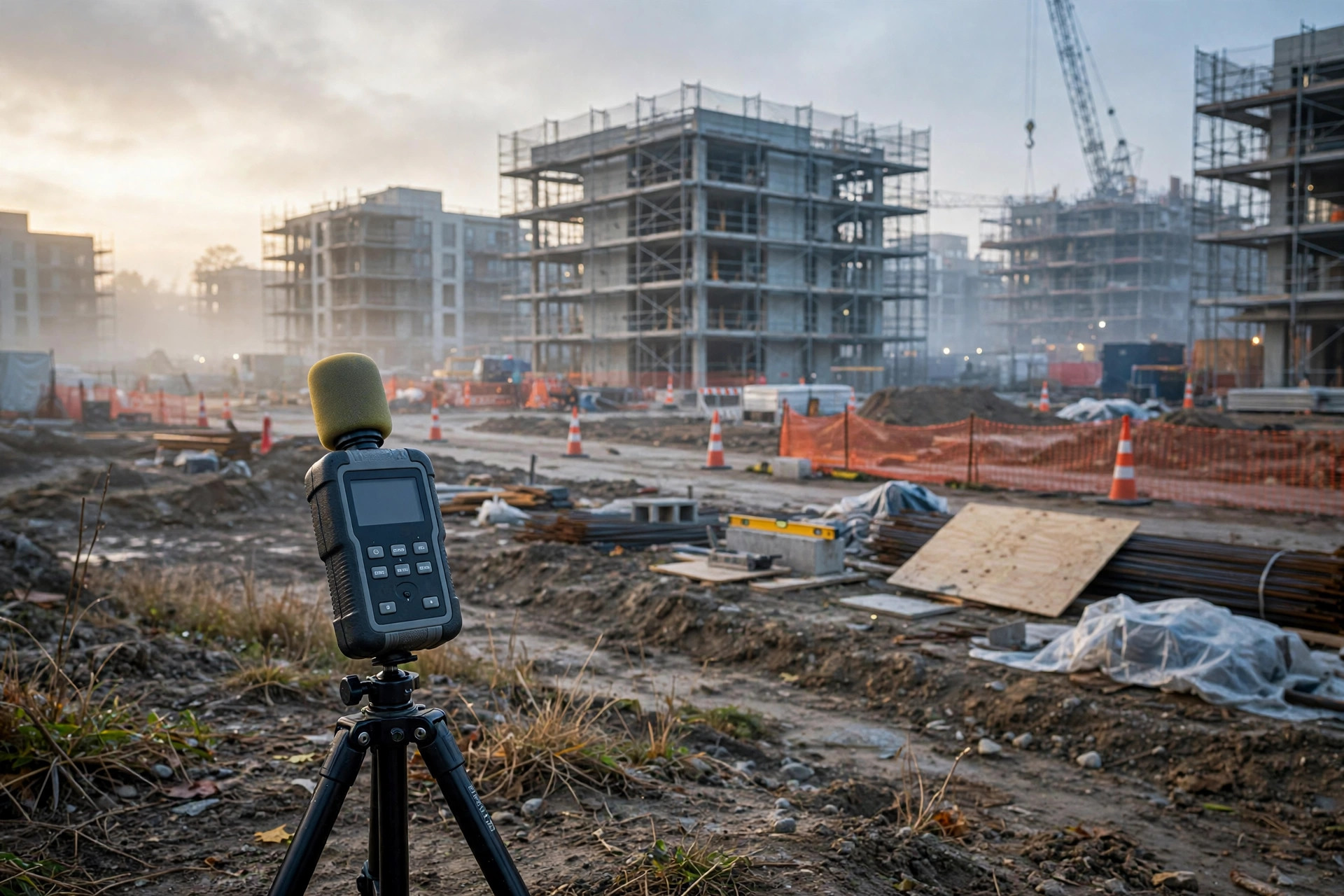
When money, compliance, or sleep depends on the number, the measurement has to be defensible. That is what a noise study is for: calibrated instruments, readings taken over time rather than in a single moment, and a report that connects the levels to the standards that apply, whether that is a local ordinance, a workplace exposure rule, or a lease negotiation. It is also how you find out whether your problem needs a barrier, absorption, sealing, or some combination before you spend on any of them.
The bottom line
Decibels reward anyone who learns three things. The scale is logarithmic, so small number changes can mean big sound changes. About 10 dB sounds twice, or half, as loud. And every reading depends on distance, weighting, and what exactly was measured.
If you are looking at a noise problem and the numbers are starting to blur together, we can help you measure first and spend second. Browse the products that match your situation, send the details through our quote request, or ask our acoustics team about a consultation before you commit to a plan. Reach out anytime at (716) 330-1147.