What a phone app actually measures
Open a decibel app, hold up your phone, and you get a number. That number feels solid, the way a thermometer reading feels solid. But a phone is not a thermometer for sound. It is a telephone that happens to have a microphone, and the app is guessing at a measurement the hardware was never built to make.
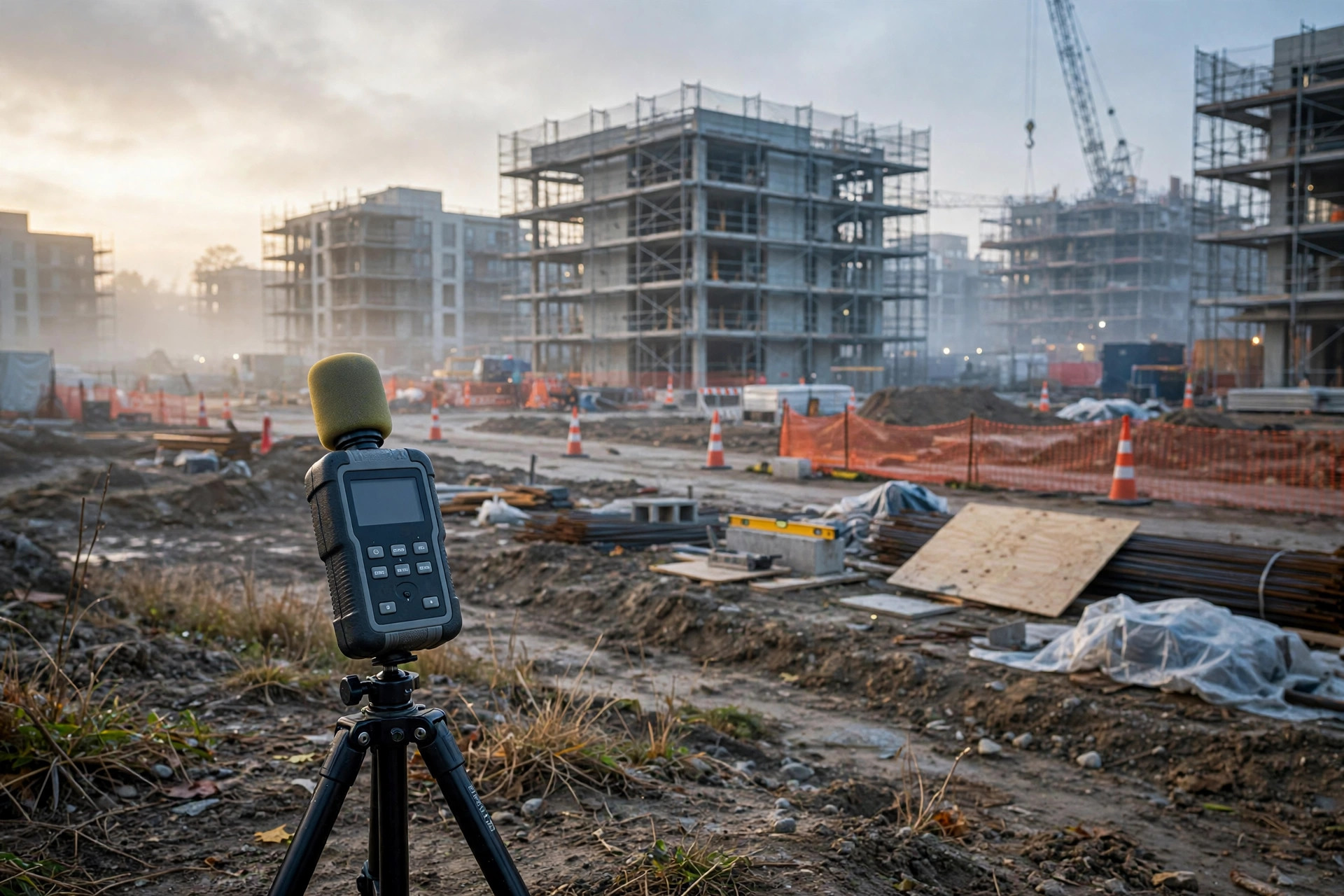
Your phone microphone is tuned for voices. It is designed to pick up speech a foot or two away, cut background noise, and keep a call clear. A sound level meter is built for the opposite job. It measures the sound in a room the way it actually arrives, across the full range of frequencies, with a microphone that has been calibrated against a known reference. That difference is the whole story.
Most apps show a number in dBA, which is a decibel reading weighted to match human hearing. That part is honest. What is not honest is the idea that the number is exact. In our own field checks, a phone app can sit several decibels away from a calibrated meter in the same room at the same moment. Several decibels sounds small until you remember that decibels are not linear. A ten decibel rise means ten times the sound energy, so a reading that is off by five decibels is not a rounding error. It is a different room, on paper.
Where phone apps do fine
None of this means the app on your phone is useless. Used the right way, it is a handy comparison tool, and comparing is exactly what most people need.
An app works well when you compare one moment to another in the same place. Is the bedroom louder at seven in the morning than at midnight? Is the living room quieter with the windows closed than with them open? Did the new door seal actually change anything? An app answers those questions, because the error stays roughly the same from one reading to the next, and the difference between the two readings is real.
An app also works as a diary. If a neighbor runs loud equipment every evening, a week of time stamped readings shows the pattern, even if each single number is approximate. Patterns persuade people. A single number does not.
Use it to find the loudest spot, too. Walk the room slowly with the app open and watch where the number climbs. That tells you where the sound is getting in, which is the first step of any fix.
Where phone apps go wrong
The problems start when the number itself has to be right. Here are the four ways an app most often misleads.
First, no calibration. A professional meter is checked against a calibrator that produces a known tone at a known level, usually before every job. Your phone has never been calibrated, and the app has no way to know how sensitive your particular microphone is. Two phones side by side, same app, same room, can disagree by several decibels. The fancier the app, the more honest it is about this. Look for the ones that let you enter a calibration offset, and remember that an offset guessed from another phone is still a guess.
Second, low frequencies. Phone microphones roll off the bass. A truck idling outside, a subwoofer through a wall, a heat pump humming at night, these are heavy in low frequencies, and they are exactly the sounds people complain about most. The app can read a quiet number while your chest feels the thump. If the noise that bothers you is a rumble, a hum, or a thud, the app is the wrong tool.
Third, loud sounds. Phone microphones clip. Above roughly the level of a loud shout, the microphone simply stops tracking the peaks, and the app reports a number lower than the truth. That matters at concerts, near construction, and next to a leaf blower, which is exactly where people reach for the app.
Fourth, the quiet end. In a truly quiet room, the app starts measuring its own electronic noise instead of the room. A reading of thirty decibels in a bedroom at night may be the phone listening to itself.
How to get the best number from an app
If you are going to use one, use it well. Hold the phone at ear height, out in front of you, away from your body and away from walls. Your body blocks sound, and a wall behind the phone reflects it. Stand in the middle of the room, not in a corner, where bass piles up.
Measure for a full minute, not a second. Sound jumps around, and a one second snapshot catches whatever happened in that second, a door closing or a car passing. A minute long average is the number that means something. Good apps show an average and a maximum. Read the average.
Note the time and the conditions with every reading. Traffic at eight in the morning is not traffic at two in the afternoon, and a reading without a time is a number without a story. Use the same app, the same phone, and the same spot every time, so your comparisons stay honest.
And keep your expectations in check. Treat the number as approximate, within a few decibels, and never as a legal fact. It is a guide, not a verdict.
When the number has to be right
There are jobs where approximate is not good enough. A noise complaint to a city, a dispute with a neighbor that may end up in front of a hearing officer, a construction project that must stay under a permit limit, a workplace that must meet an occupational standard, a home purchase next to a freeway, a school or a hotel that needs to prove its rooms are quiet. In each of these, the number is the evidence, and evidence has to come from calibrated equipment, a documented method, and a person who can stand behind it.
The same is true of testing. A wall rating or a floor rating, the STC and IIC numbers that show up in building codes and product sheets, cannot be measured with a phone at all. They need a loudspeaker on one side, a calibrated meter on both sides, and a procedure that controls the room itself. That is a noise study, not an app reading.
It is also true when real money is on the line. If you are about to spend thousands of dollars on windows, a wall build up, or a full room treatment, a wrong number can point you at the wrong fix. We have seen homeowners replace windows when the sound was coming through the door, and add panels to a wall when the culprit was the floor above. A measured study finds the actual path before the money moves.
The short version
Your phone app is a fine compass and a poor map. It can tell you that one room is louder than another, that tonight is worse than last night, and that a fix helped or did not. It cannot tell you the exact level in your room, it cannot hear the bass your body feels, and it cannot produce a number a city, a court, or a building inspector will accept.
So use the app for what it is good at. Walk the room, find the loud spots, keep a diary, and compare before and after. Then, when the decision matters, get the sound measured properly. A calibrated meter, a trained ear, and a written report turn a guess into a plan.
If a noise problem is costing you sleep, tenants, guests, or a permit, request a free quote at silentical.com/quote/ or call (716) 330-1147. We measure noise across Escondido and San Diego County with calibrated equipment, and we tell you what the number means and what to do about it.