
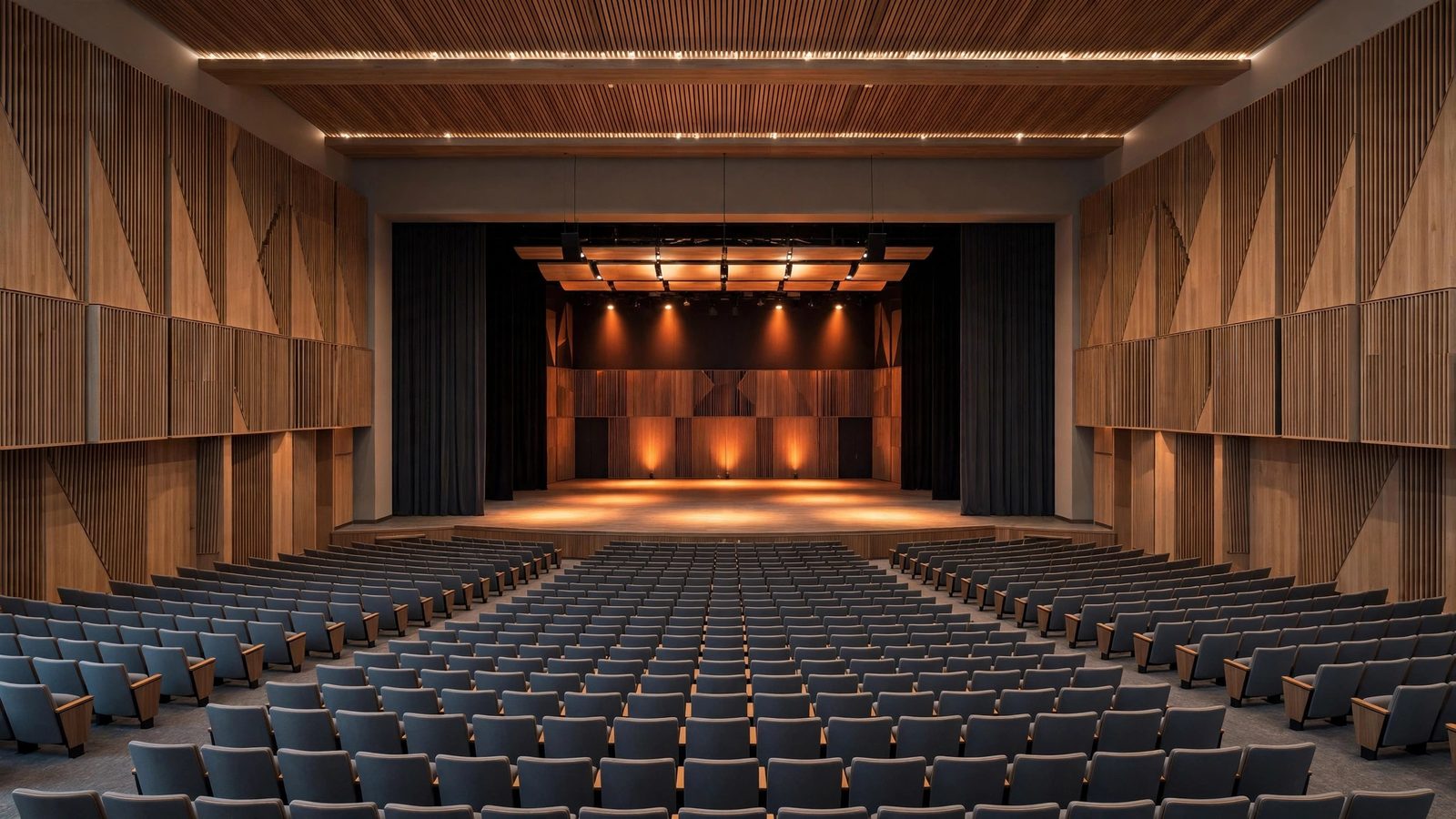
Why club sound gets out
A nightclub is a room built to be loud inside and quiet outside, and those two jobs fight each other all night. Inside, the music has to hit hard enough that a full dance floor feels it in their chest. Outside, the neighbors want to sleep, the street wants to stay calm, and the city wants the sound to stay inside the building. When a club works, both things happen at once. When it does not, the music leaks out in ways that surprise owners, because sound does not leave a building the way people picture it.
Most people picture sound leaking through the walls, like water through a thin cup. Some of it does. But most of the sound that reaches a neighbor takes a sneakier path. It slips through the gap under a door, it rides out an open window or a vent, and it shakes the frame of the building so the bass shows up two doors down. A club that only treats the walls is fixing one leak in a bucket that has five.
Nightclub noise is not one problem. It is a set of small paths, and the loudest path decides how much the neighbors hear. Find the loudest path first, fix that, and then find the next one. Work through them in order and the room gets quieter outside while staying just as alive inside.
Doors, windows, and thin walls
Start with the door, because the door is almost always the weakest link. A club door opens and closes all night, and every time it opens, a wedge of sound walks out into the street. The gap under the door is worse. A gap you can slide a finger under is a highway for sound, and a standard hollow door barely slows anything down. A solid door, a proper seal around all four edges, and a drop seal at the bottom change the picture fast. A second door, set up as a small entry vestibule so one door is always closed while the other opens, is one of the best investments a venue can make. It costs far less than rebuilding a wall, and it fixes the leak the neighbors hear most.
Windows are the next gap. A single pane of glass is a poor sound barrier, and a window left open for air is no barrier at all. If a venue has windows facing homes, they need to stay shut during loud hours, and the glass itself may need an upgrade. Sealing the frames matters too, because sound loves a crack and an old window frame has plenty of them.
Then come the walls. A thin stud wall with a single layer of drywall on each side will pass a surprising amount of sound. Adding mass helps, and a second layer of drywall, sealed at the edges, makes a real difference. A wall that is heavy, sealed, and separated from the frame on one side is a wall that earns its keep.
Bass is the hardest part
Here is the part that catches most venues off guard. The vocals and the guitars are not usually what wake the neighbors. The bass is. Low notes carry long wavelengths, and long wavelengths pass through walls, floors, and ceilings that stop higher sounds with ease. Bass also travels as vibration through the structure itself. A subwoofer sitting directly on a wood floor can shake the joists, and the joists carry that shake into the rooms next door and below. The neighbor may not hear the melody at all, just a thump in the wall at one in the morning, and that thump is what gets the complaint filed.
This is why foam panels on a wall will never fix a bass complaint. Foam and thin acoustic panels treat echo inside a room. They make the room sound better to the people in it. They do almost nothing to stop bass leaving the building. Treating the inside of a room and soundproofing a room are two different jobs, and confusing them is the most common money waster in this business. Panels help the sound inside. Mass, sealing, and decoupling keep sound from getting out.
What actually works, in priority order
Fixes work best in order, from the cheapest and most effective to the biggest jobs. First, seal every air gap. Doors, windows, vents, pipe openings, and any crack where light shows through. If air can pass, sound can pass, and sealing is the lowest cost fix with the fastest payoff.
Second, fix the door properly. A solid core door, full perimeter seals, a drop seal at the bottom, and a vestibule or double door entry if the layout allows it. The front door is the face of the venue and the biggest single leak, so it deserves the attention.
Third, add mass and separation to the walls and ceiling that face neighbors. A second layer of drywall, sealed tight, is a strong start, and the ceiling matters as much as the walls when there are homes above.
Fourth, deal with the floor and the bass. Isolate the subwoofers and keep them off shared walls, so vibration does not travel through the structure. This is the step most venues skip, and it solves the complaints that survive the first three.
Fifth, treat the room itself. Panels make the music clearer inside, so the system does not have to be pushed as hard to sound good. A room that sounds good at a lower level leaks less sound outside.
Speakers, placement, and the room itself
Where the speakers point matters as much as how loud they are. A speaker aimed at a thin shared wall is firing sound straight at the weakest point in the room. Turn that speaker toward the dance floor, keep the cabinets off the shared wall, and the neighbors hear less while the crowd hears more. Speakers hung high and aimed down at the crowd waste less energy on the walls and ceiling too.
When a noise study matters
Some venues can fix the obvious leaks and move on. Others need numbers, and that is where a noise study comes in. A noise study is a calibrated measurement of how loud the venue actually is, inside and at the property line, done with a real sound level meter and written up as a report. It is not a phone app reading. It is a measurement the city and the neighbors can trust.
A study matters in a few clear cases. When a venue applies for a permit or a license, the city may ask for proof that the sound will stay within the rules. When neighbors complain, a study shows what is actually happening at their property line, instead of leaving everyone to argue about feelings. When a venue plans a renovation or a new sound system, a study taken before and after shows whether the money spent actually worked.
What to do first in Escondido and San Diego County
Nightclubs, bars, and live music venues across Escondido and San Diego County share the same pattern. The venue sits close to homes or apartments, the music runs late, and the first complaint arrives on a weekend night. The fix starts with a walk through the building after dark, listening at the doors, the windows, and the property line while the system plays at a normal show level.
From there, the order is simple. Seal the gaps, fix the door, add mass where the neighbors are closest, isolate the bass, and then treat the room so it sounds great at a lower level. If a permit, a complaint, or a new sound system is in play, get a calibrated noise study done so the work is guided by real numbers instead of guesses.
A great club night should end with the crowd talking about the music, not the neighbors talking about the noise. The fixes that make that happen are practical, they are proven, and they start with finding the loudest path out of the room. If your venue is fighting complaints or planning a sound upgrade, request a free quote at silentical.com/quote/ or call (716) 330-1147, and we will help you keep the music inside and the neighbors happy.