
Watch the 45 second version on YouTube.
The loudest small room in the house
A laundry room is small, hard, and loud. The washer thumps through the spin cycle, the dryer hums and rattles, water pipes knock when the machine fills, and every sound bounces off tile, bare walls, and a hollow door. Close the door and you can still hear it in the next room. If the laundry room shares a wall with a bedroom, you hear it at night too.
This guide explains what actually quiets a laundry room, in plain English. The room makes two kinds of noise, and each one needs a different fix. Some fixes cost almost nothing. Some are worth doing only when the room is already being remodeled. If you know which kind of noise you are hearing, you can spend money on the fix that works and skip the rest.
A laundry room makes two kinds of noise
The first kind is vibration. A washer on spin cycle shakes. That shake travels through the feet of the machine into the floor, and the floor carries it into the walls and the rooms below and beside it. You feel it as much as you hear it, a low thump that repeats with every spin. A dryer adds its own shake, and a machine that is not level shakes more than one that is.
The second kind is airborne sound. The motor, the water, the drum, and the dryer fan all make sound in the air, and that sound leaves the room through the gaps around the door, through a hollow door itself, through the vent, and through the walls. A laundry room is usually full of hard surfaces, tile or vinyl on the floor, bare drywall, a metal door, so the sound inside the room bounces around and feels louder than it is.
That split matters, because a fix for one kind does nothing for the other. Soft panels on the wall calm the echo inside the room, but they do not stop the shake from traveling through the floor. Rubber pads under the machine calm the shake, but they do nothing for the sound leaking under the door. A quiet laundry room needs a fix for both.
One: stop the vibration at the machine
Start at the machine, because it is the source and the cheapest place to fix it. First, level the washer. A washer with one foot off the floor rocks with every spin, and a rocking washer is a loud washer. Turn the feet until the machine sits flat and does not rock when you push a corner. A simple level on top of the machine tells you when it is right, and most washers let you adjust the feet by hand.
Second, put rubber pads under the feet. Vibration pads sit under each foot and soak up some of the shake before it reaches the floor. They work best on a solid floor, concrete or a ground floor slab, and they help less on a springy wood floor upstairs, because the floor itself still moves. They are cheap, they take minutes to fit, and they are the first thing to try in any laundry room.
Third, check the load. An unbalanced load is the most common reason a washer suddenly gets loud. One heavy towel on one side of the drum throws the spin off balance, and the machine walks across the floor. Spread the load evenly, and do not overload the drum. If the machine still walks after it is level and loaded evenly, the floor may be too flexible, and that is a structure problem, not a machine problem.
A note on the floor itself. A washer on a concrete slab is far quieter than the same washer on a wood framed floor upstairs, because concrete does not flex and carry the shake the way wood does. If you are choosing where a laundry room goes in a remodel, the ground floor is the quiet choice. If the machines are already upstairs, pads and leveling help, and a thick rubber mat under the machines adds a little more, but no pad can make a springy floor behave like concrete.
Two: seal the door and the gaps
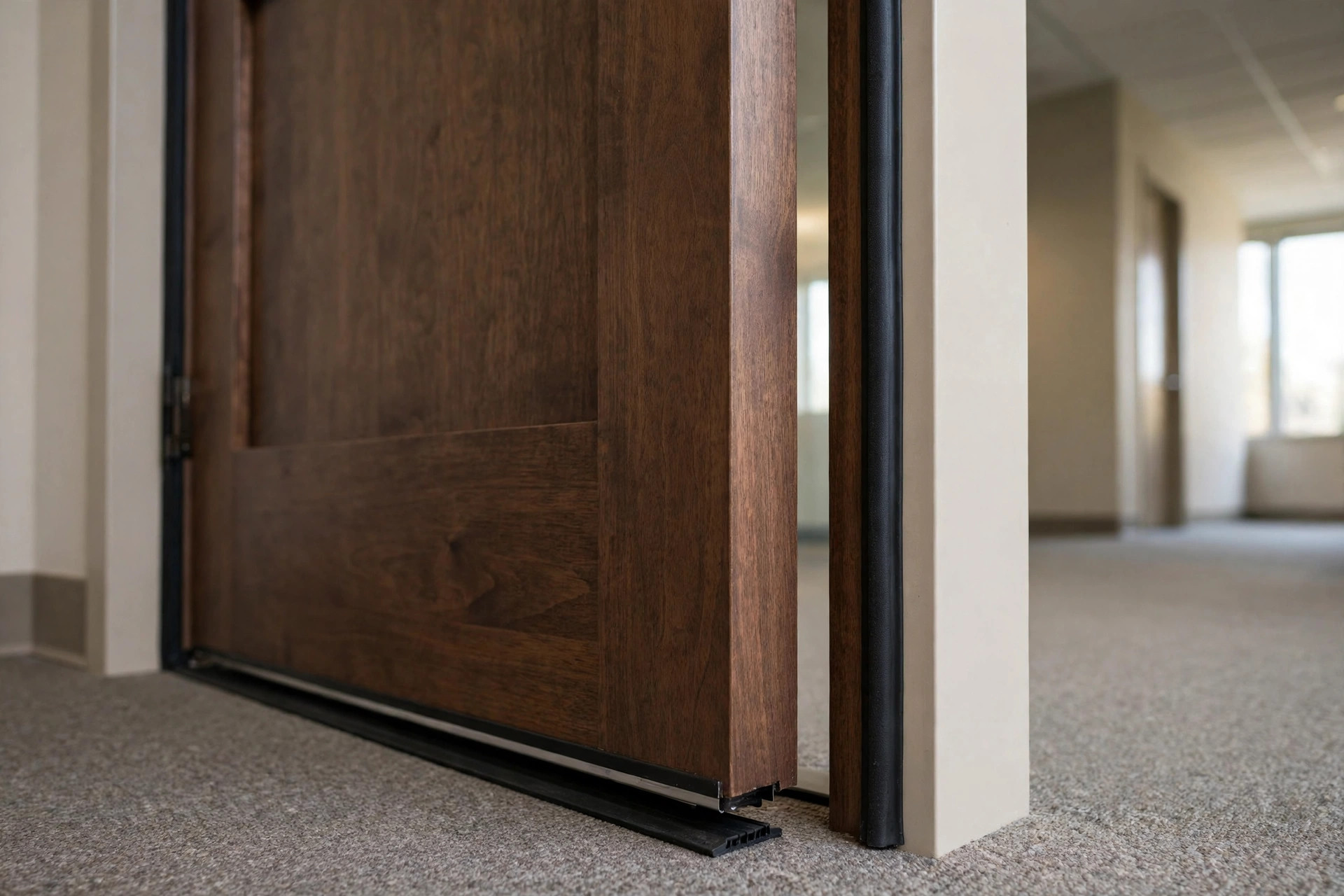
The door is the weakest part of most laundry rooms. Builders fit hollow doors in laundry rooms, and a hollow door is mostly air, so sound passes through it easily. The gap underneath the door is worse. A half inch gap under a laundry room door lets out more sound than the whole door does, and it is the first thing to fix.
Fit a sweep on the bottom of the door, and seals around the frame. A sweep is a strip that closes the gap at the floor, and perimeter seals close the gaps at the sides and the top. Together they turn an open doorway into a closed one, and the room gets noticeably quieter from the hallway side. It is a small job, it costs little, and it is the fix people notice most for the money.
If the door is hollow and the room still leaks sound after sealing, a solid core door is the next step. A solid core door is heavy, and heavy blocks sound. It is the same mass idea that works in walls, and a laundry room door is a small, easy place to use it. Keep the sweep and the seals when you change the door, because a heavy door with a gap underneath it leaks just as much as a light one.
Then walk the room and find the other gaps. Pipes pass through the wall to the washer, the dryer vent passes through the wall to the outside, and every one of those holes is a path for sound. Seal around pipes and the vent with acoustic sealant, the kind that stays flexible after it cures, so it keeps sealing as the building moves. A bead of sealant around a pipe is a five minute job, and it closes a leak that foam and panels never touch.
Three: add mass to the shared wall
If the laundry room shares a wall with a bedroom or a living room, the wall itself may be the problem. A single layer of drywall on each side of a stud wall is light, and the washer and dryer push sound straight through it. The fix is the same as for any shared wall: add weight.
A second layer of drywall on the laundry room side makes the wall heavier and harder to shake, and mass loaded vinyl between the layers adds weight without much thickness. A damping compound between the two layers helps too, because it turns the vibration into heat instead of passing it along. Our guide to soundproofing a wall explains all four methods in detail, and the same methods apply here.
This is a remodel job, not a weekend fix, so it makes sense only when the room is already being opened up or when the noise is bad enough to justify it. If the machines sit against a shared wall, move them first if you can. A washer on a different wall, away from the bedroom, is often quieter than a washer rebuilt into the same wall with more drywall.
Four: calm the echo inside the room
Soft panels on the laundry room wall make the room feel quieter to stand in. They absorb the sound bouncing between the hard surfaces, so the spin cycle sounds less sharp and the room is easier to be in while you fold clothes. Fabric acoustic panels work, and so does a thick rug on the floor in front of the machines.
Be clear about what this fix does and does not do. Panels calm the echo inside the room. They do not block sound from getting through the wall, and they do not stop the shake from traveling through the floor. They are a comfort fix, not a blocking fix, and they belong after the vibration, the door, and the wall, not before them.
That order is the mistake most people make with laundry rooms. They hang foam on the wall first, because it looks like the answer, and then they wonder why the bedroom still shakes at night. Foam is light, and light materials do not block sound. Start at the machine, then the door, then the wall, and save the panels for last.
What does not work
Egg cartons do not soundproof a laundry room. They are light, thin cardboard, and they add no mass and stop no vibration. They scatter a little sound inside the room, and that is all. Our guide to egg cartons explains why in detail.
Acoustic foam panels do not block sound through the wall either. They are made to control echo inside a room, and they do that job well. But hanging foam on a laundry room wall does nothing about the shake in the floor or the gap under the door, and those are the paths the noise actually takes.
A curtain over the doorway is another one to skip. A curtain is light, it hangs in front of the gap instead of sealing it, and sound goes around it easily. It may make the room look finished, but it does not make it quieter. The same goes for a thin rug under the machines: it looks like padding, but a thin rug compresses flat under the weight of a washer and stops almost no vibration. A thick rubber mat made for the job is the one that helps.
Putting the fixes in order
Here is the order that makes sense for most homes. First, level the washer and put rubber pads under the feet, and check the load when the spin gets loud. Second, fit a sweep and seals on the door, and seal around the pipes and the dryer vent. Third, if the wall is shared with a bedroom, add a second layer of drywall with damping compound on the laundry room side, or move the machines to a different wall. Fourth, add soft panels or a rug to calm the echo inside the room.
Each step helps on its own, and the first two cost the least and change the most. Many people find the room is already much quieter after leveling the machine and sealing the door, and the bigger fixes become a choice instead of a necessity.
If you rent, or the machines are upstairs
Renters cannot rebuild a laundry room, and a washer upstairs on a wood floor is the hardest case of all. There are still steps that help. Level the machine, fit rubber pads under the feet, and keep loads balanced. A thick rubber mat under the machines is a renter friendly fix that a landlord rarely objects to, and a draft stopper under the laundry room door closes the biggest gap in the room.
Run the loud loads at a time that suits the household, and use the quiet or night cycle if the machine has one. A white noise machine or a fan in the bedroom can mask the sounds that remain, which is not the same as blocking them, but it can be the difference between sleeping and lying awake. If the shake is strong enough to rattle pictures on the wall below, that is a structure question, and it is worth raising with the landlord or the building owner.
When to call for a measurement
Some laundry room noise is a building problem, not a shopping problem. If the washer shakes the floor in the room below, if the dryer hum can be heard through two closed doors, if you are planning a remodel and want to know whether the fix is the floor, the wall, or the door first, a measurement tells you the truth. A noise study finds the path the sound is taking, whether it is vibration through the structure or airborne sound through the gaps, and a consultant can tell you which fix comes first and which ones you can skip.
If the laundry room is part of daily life in your house, or your tenants keep mentioning the washer at night, request a free quote at silentical.com/quote/ or call (716) 330-1147. Tell us where the machines sit, what rooms share the wall and the floor, and what you hear most, the thump of the spin, the hum of the dryer, or the knock of the pipes, and we will tell you which fix comes first.