
The myth that will not die
Walk into almost any home studio, practice room, or rented rehearsal space and you will see the same thing on the wall: egg cartons, glued up in neat rows, sometimes painted, sometimes stacked two deep. The idea has been around for decades. It looks like it should work. The carton has cups and bumps, and bumps must break up sound, or so the thinking goes. It does not work. An egg carton on a wall will not stop sound from reaching the next room, and it will not stop the neighbors from hearing you either. This guide explains why, in plain English, and what actually does the job instead.
Why an egg carton cannot block sound
Sound that travels through a wall is stopped by weight. A wall blocks sound because it is heavy and stiff, and the sound has to push all that weight to get through. An egg carton weighs almost nothing. It is thin cardboard pressed into cups, and thin cardboard has no weight to push against. Sticking it on a wall is like putting a paper napkin on a window and expecting it to keep out the cold. The shape does not matter. The bumps and cups change how sound bounces around inside the room a little, but they do nothing at all about sound passing through the wall to the other side.
That is the first thing to understand about soundproofing a wall: blocking sound and calming echo are two different jobs, and the materials for one do almost nothing for the other. Egg cartons fail at both jobs in practice. They are too thin and too light to block sound, and their shape is too shallow and too random to calm echo in any useful way. A room lined with egg cartons is still loud inside, and still loud next door.
There is also a practical problem nobody mentions until it is too late. Egg cartons are cardboard, and cardboard burns easily. A wall covered in dry cardboard next to a lamp, a heater, or a guitar amplifier is a fire risk, and it collects dust in every cup. It also looks terrible, which matters if the room is a home office on video calls or a studio where clients walk in. The myth survives because cartons are free and the job looks finished once the wall is covered. The wall is covered. The sound is not stopped.
What foam actually does, and what it does not do
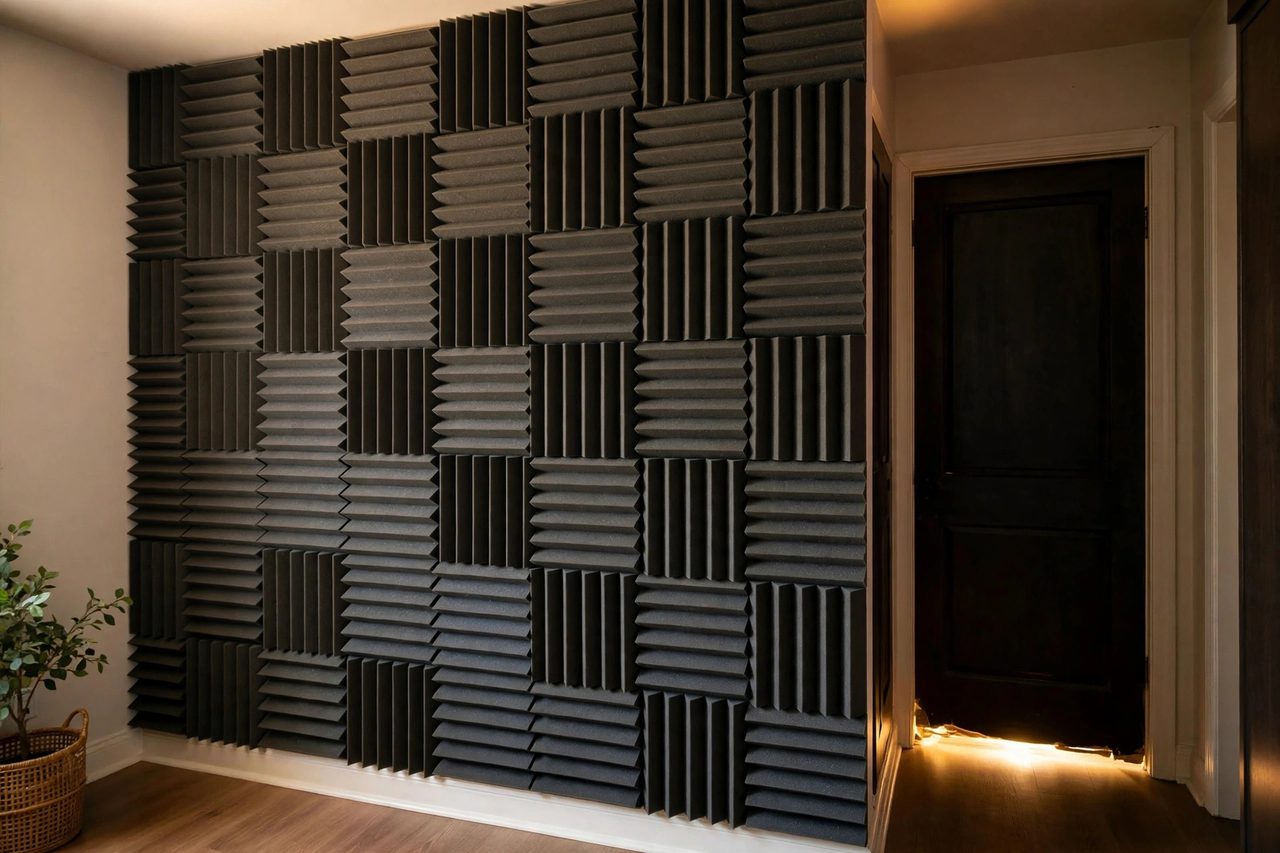
Acoustic foam is the grown up version of the same mistake. Foam panels on a wall calm the echo inside the room. They soak up the reflections that make a room sound sharp and hollow, and that is a real benefit in a recording space or a home office. What foam does not do is stop sound from going through the wall. A foam panel is light, soft, and thin, and sound passes through it and through the wall behind it almost as if it were not there.
This is the confusion at the heart of most failed soundproofing jobs. People buy treatment and expect blocking. Treatment changes how a room sounds inside. Blocking changes how much sound gets out. Foam, cartons, blankets, and curtains are treatment. They make the room you are in sound better. They do not make the room next door quieter. If the problem is the neighbor hearing your television, or you hearing the neighbor, treatment alone will not fix it, no matter how much of it you put up.
What actually blocks sound through a wall
Three things block sound through a wall, and they work in this order: weight, sealing, and separation. Weight is first because it does the most work. A second layer of drywall on the wall adds real mass, and mass is what sound has to push through. Mass loaded vinyl under that second layer does the same job in a tight space, adding weight without adding much thickness. A single layer of drywall on light studs is a thin wall, and a thin wall is a loud wall. Add a layer and the whole wall gets quieter.
Sealing is second, and it is the cheapest fix on this list. Sound leaks through gaps the way water leaks through a crack. A wall can be heavy and still leak sound around the edges: around the outlet boxes, around the pipes where they pass through, around the door frame, and under the door itself. Each gap is small, but together they add up to a real hole in the wall. Acoustic sealant around the outlets and the pipe penetrations, and a sweep plus seals on the door, close those leaks. All of it takes an afternoon and costs less than a dinner out.
Separation is third. A wall with two separate frames, or with resilient channels that hold the drywall away from the studs, breaks the direct path sound takes through the solid wood. Sound has to jump a gap instead of riding straight through the stud, and most of it does not make the jump. This is a bigger job than adding a layer of drywall, and it usually belongs in a remodel or a new build, but it is the fix that turns a shared wall from loud to quiet in a home studio or a duplex.
The order to fix a noisy wall
Start cheap and work up, and test as you go. First, seal the gaps. Acoustic sealant around every outlet box on the noisy wall, around the pipes, and around the door frame. Put a sweep on the bottom of the door and seals around the sides and the top. Stand in the next room while someone talks on the other side and listen for the change. Sealing alone often takes the edge off the worst of it, and it tells you how much of the problem was leaks rather than the wall itself.
Second, check the door. A hollow door lets more sound through than the wall does, and no amount of work on the wall will fix a door that is basically cardboard. A solid core door replaces the hollow one with real mass, and with the sweep and seals already in place it closes the biggest hole in the room. If the door is the weak point, this one change can be the whole fix.
Third, add weight to the wall. A second layer of drywall on your side of the shared wall, with acoustic sealant around the edges, adds the mass the wall was missing. Mass loaded vinyl under that layer adds more weight in the same thickness. This is the step that stops voices and television sound, the sounds that carry words and keep people awake.
Fourth, if the wall still carries too much sound, look at separation. Resilient channels or a second frame break the path through the studs. This is the step to plan into a remodel, and it is the step to ask a consultant about before you open the wall up, because the details matter: one rigid connection between the two sides can undo the whole job.
Mistakes to skip
Do not cover the wall in egg cartons. Do not cover it in foam and expect the neighbors to go quiet. Do not hang a thick blanket and call the room soundproofed. Blankets and curtains calm echo inside the room, which helps how the room sounds, but they do not block sound from leaving it. Do not stuff the wall cavity with loose insulation and expect silence either. Insulation inside the wall helps, but on its own it does not add the weight that stops sound. And do not buy a white noise machine and call it fixed. A white noise machine is a mask, not a fix. It covers the neighbor's television with a different noise, and the moment it switches off the television is still there.
When to call for a measurement
Some wall noise is a building problem, not a weekend job. If you can hear whole conversations through a shared wall, if a home studio or a practice room is drawing complaints from the neighbors, or if you are planning a remodel and want to know whether the fix is a second layer of drywall, a different door, or a separated frame, a measurement tells you the truth. A noise study finds the path the sound is taking, whether it is the wall, the door, the floor, or the gaps around all three, and a consultant can tell you which fix comes first and which ones you can skip.
If the noise through your wall is part of daily life, or your neighbors keep mentioning it, request a free quote at silentical.com/quote/ or call (716) 330-1147. Tell us what you hear most through the wall, voices, music, or television, and we will tell you which fix comes first.