
Find the gaps first
A door that looks closed can still leak sound through gaps you can barely see. The frame around a normal interior door is not airtight, and the gap at the bottom is often wide enough to slide a finger under. Sound behaves like water here. It does not push through the door itself. It finds the open path and pours through it.
Start with the light test. Wait until evening, close the door, and turn the light on in the room on the other side. Stand in the dark room and look at the edges of the door. Any line of light is a gap, and every gap is a path for sound. Check the bottom, both sides, and the top. Most doors fail this test in more than one place, and that is good news, because each gap has a simple fix.
Then try the paper test. Close the door on a sheet of paper and pull it. If it slides out with no resistance, the door is not pressing against anything on that side. If it holds tight, that side is already sealed. Do this at the top, the middle, and the bottom of each side. It takes a minute, and it tells you exactly where to spend your effort.
Last, run your hand slowly around the frame with the door closed and a noisy room on the other side. You can often feel the air moving through the gap before you can see it. Note every spot. You are about to fix them in the order that matters most.
The bottom gap is the biggest leak
Start at the bottom, because the gap under a door is usually the biggest opening in the whole frame. A typical interior door sits a half inch or more above the floor, and that slot runs the full width of the door. It can leak more sound than the rest of the frame put together.
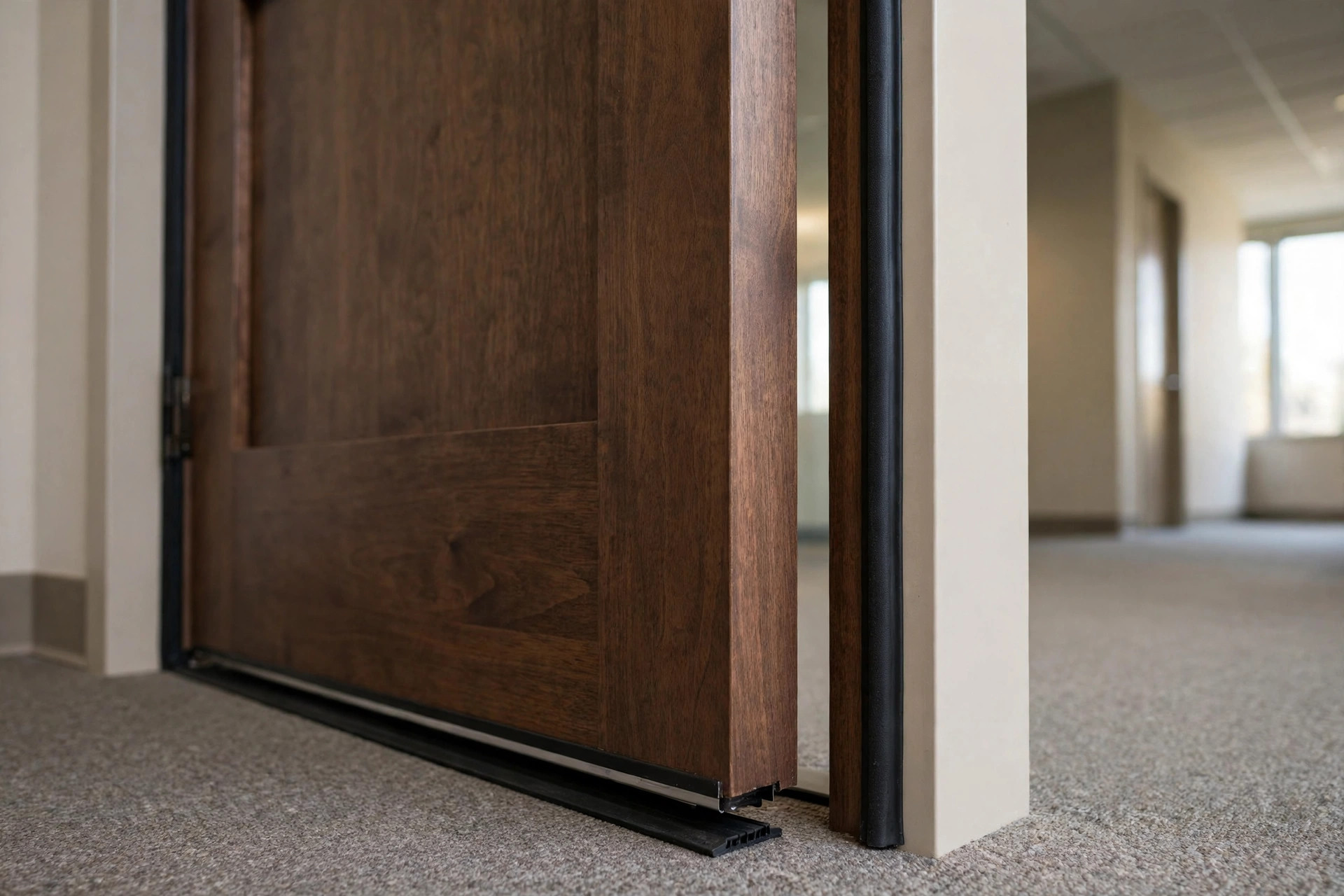
A door sweep fixes it. A sweep is a strip that fastens to the bottom of the door and brushes or presses against the floor when the door closes. The simplest kind is a brush or rubber strip that screws to the face of the door. It takes a drill, a few screws, and ten minutes. Peel and stick versions exist too, and they work well on a smooth door bottom if the surface is clean and dry first.
If the gap is uneven, or the door swings over a rug on one side and bare floor on the other, use an automatic drop seal. It sits in a groove or on the face of the door bottom, and a small plunger presses against the frame when the door shuts, dropping the seal down to the floor. It costs more than a fixed sweep, and it is the right answer when a fixed sweep would drag or leave a gap at one end.
Test the fit when you are done. Close the door and look for light under it again. If the light is gone, the sweep is doing its job. Open and close the door a few times. It should move freely without dragging, and the sweep should touch the floor across the full width.
Seal the sides and the top
With the bottom closed, work around the rest of the frame. The sides and the top need weatherstripping, a compressible strip that the door presses against when it closes. The strip fills the gap between the door edge and the frame, and the door squeezes it shut every time it closes.
Foam tape is the easiest place to start. It comes in a roll with a sticky back, you cut it to length, and you press it into the frame where the door meets it. Use the closed cell kind, the dense foam that springs back when you press it, not the soft open cell kind that stays flat. Measure the gap first. Foam tape comes in different thicknesses, and the right one is a little thicker than the gap it has to fill.
V strip is the tougher option, and it lasts longer. It is a folded strip of plastic or metal that springs open against the door edge. It takes more care to fit, because it has to sit straight in the frame, but it holds its shape for years and it does not go flat the way foam can.
Silicone bulb seals are the third option, and the best one for a door that gets used hard. A soft silicone tube sits in a groove or on a small carrier, and the door compresses it when it closes. It seals well, it stays flexible in heat and cold, and it keeps working after thousands of closes. It costs more than foam tape, and it is the one we reach for on a bedroom door or a home office door that gets opened and closed all day.
Whichever kind you pick, fit it on the frame, not on the door edge, and run it around the full perimeter. A seal with a gap at the top corner is a seal with a leak. Close the door and repeat the light test. The frame should be dark all the way around.
Check the latch
A seal only works if the door pulls tight against it when it closes. That is the latch's job, and a loose latch is the most common reason a new seal still leaks. Close the door and push on it gently. If it moves or rattles, the latch is not holding it tight.
First, tighten the screws on the strike plate, the metal plate on the frame that the latch catches on. Screws in a door frame work loose over years of use, and a plate that has shifted a fraction of an inch can leave the door sitting loose in the frame. If the screw holes are stripped, use longer screws that reach into the stud behind the frame. That one change often pulls the whole door tighter.
Then check the latch itself. With the door open, press the latch bolt in with your finger. It should spring back out smartly. If it sticks or moves slowly, clean it and add a drop of light oil. A latch that does not spring fully out will never hold the door tight, no matter how good the seal around it is.
If the door still sits loose after that, the strike plate may need to move. Loosen it, shift it a hair toward the room so the latch pulls the door in tighter, and retighten. Small moves only. A sixteenth of an inch is often enough, and too much will make the door hard to close.
When sealing is not enough
Sealing fixes the gaps, and the gaps are the main leak in most doors. But a seal cannot fix a door that is too light to block sound on its own. A hollow core door, the light kind with a cardboard honeycomb inside, lets sound straight through the panel even when the frame is perfectly sealed.
Here is how to tell what you have. Knock on the door. A hollow core door sounds empty and drumlike. A solid core door sounds dull and heavy. If the knock says hollow, and the room still carries sound after sealing, the door itself is the next step.
The usual upgrade is a solid core door in the same frame. It weighs far more, it blocks far more sound, and it takes the same hinges and the same latch. It is a bigger job than a sweep and a roll of foam tape, but it is still a job a handy homeowner can do in an afternoon, and it is far cheaper than a purpose built acoustic door.
A door kit, a sweep plus seals plus a threshold, can also help a hollow door, and it is worth trying before replacing the door. But if the panel is the problem, no seal will make it heavy. Our guide to the door as the weak link explains when a kit is enough and when a real acoustic door is the answer.
What to skip
A towel rolled up at the bottom of the door is a fine test, not a fix. It shows you how much of the noise comes through that gap, and that is useful information. It is not a seal, it slides out of place, and it does nothing for the sides and the top.
Skip the foam tape on the door edge too. Tape on the moving edge gets crushed and torn, and it falls off within weeks. Tape belongs on the frame, where the door presses against it without sliding across it.
And skip sealing a door that a room needs for air. A bedroom with a single supply vent and no return path can go stuffy if the door is sealed tight, and a room with a gas appliance needs its air path. If the room feels stuffy after sealing, talk to us before you seal it tighter. A transfer grille or an undercut on a different door can give the air a path that does not give the sound one.
The order that works
Put it together in this order, and stop when the room sounds right. First, find the gaps with the light test and the paper test. Second, close the bottom gap with a sweep or a drop seal. Third, seal the sides and the top with weatherstripping. Fourth, tighten the latch so the door pulls snug against the seal. Each step is cheap, each one takes minutes, and most doors are quiet after the second step.
If the door still carries sound after all four steps, that is the point to call us. A short noise study can show whether the sound is coming through the door, the wall, or the floor, and the fix follows the measurement instead of a guess. Request a free quote at silentical.com/quote/ or call (716) 330-1147. Tell us which room the door is on, what is on the other side, and whether the door is hollow or solid, and we will tell you whether the gap, the door, or the wall is the place to start.