
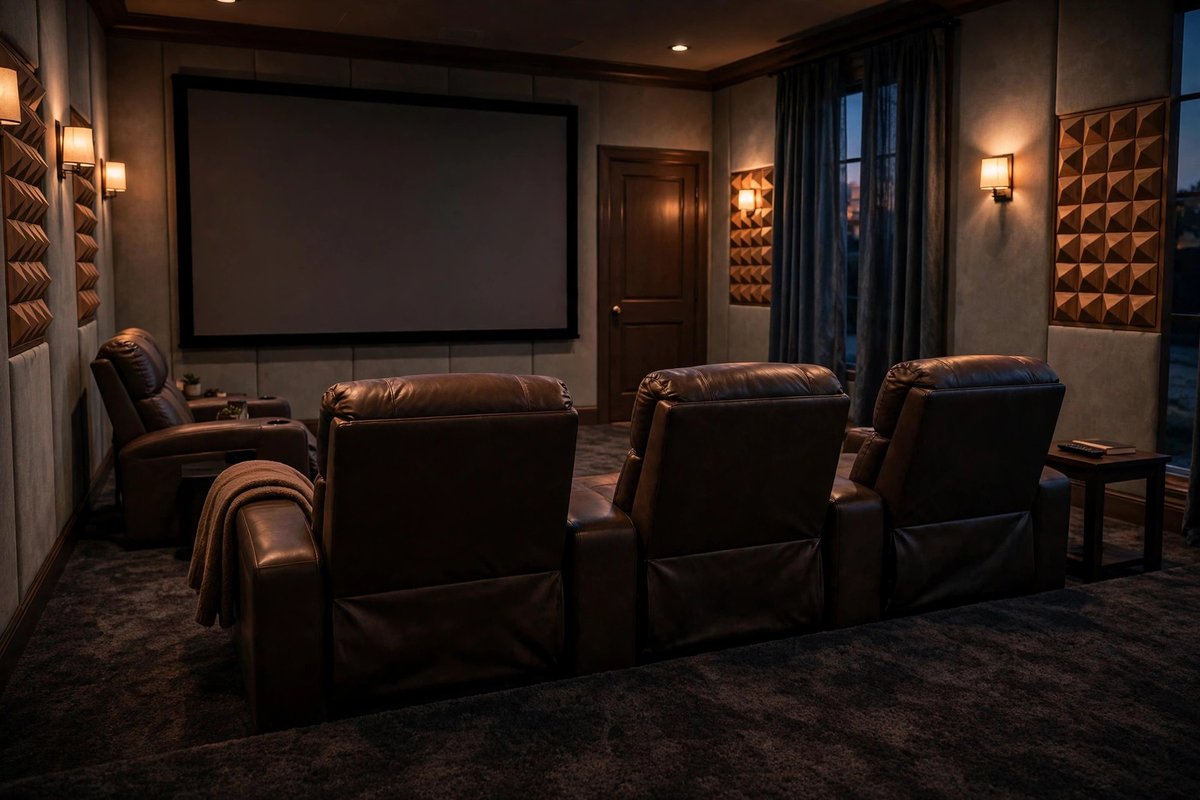
A home theater asks a room to do two things at once: keep the sound inside, so a late movie does not wake the rest of the house or bother the neighbors, and make the sound inside the room clear, so dialogue is easy to follow and music does not turn muddy. These are two different jobs, and mixing them up is the most common reason a home theater still sounds wrong after money has been spent on it.
Soundproofing and acoustics are not the same thing
Soundproofing stops sound from traveling through walls, floors, and ceilings. Acoustic treatment is about how sound behaves once it is inside the room. Foam panels will make a room less echoey, but do almost nothing to stop bass reaching the bedroom upstairs. And a well sealed, heavy room can still sound harsh inside if nothing is done about reflections. Outside noise, or other people hearing your theater, is a soundproofing problem. Unclear, echoey, or uneven sound inside is an acoustics problem. Most home theaters need some of both, and the order matters.
Start with soundproofing
Soundproofing should come first, because there is no point fine tuning the sound inside a room while outside noise is still leaking in, or while your subwoofer is shaking the floor above. The principles are simple, even if the work is not. Mass blocks sound, so heavier walls block more than light ones. Sealing matters just as much, because sound pours through even a small gap around a door, a vent, or an electrical box. And separating surfaces helps, because sound travels easily through a rigid connection like a shared stud or joist.
In practice, look first at the weakest points. Hollow interior doors are a common one, and a solid core door with proper seals makes a real difference. Gaps around doors and windows should be sealed. Walls can be improved with a second layer of drywall, ideally with a damping layer between the layers so vibration turns into a tiny amount of heat instead of passing straight through. Floors benefit from thick carpet and pad, and from isolation pads under subwoofers and speakers so vibration does not travel straight into the structure.
You do not have to do the whole room at once. Treating the wall shared with a bedroom, or the ceiling under one, will help that room even if the rest of the theater is untouched. But partial work has a limit: sound takes the easiest path it can find, so a treated wall next to an unsealed hollow door will still leak.
Then fix how the room sounds inside
Once the room is reasonably sealed, the inside gets its turn. Hard, bare surfaces bounce sound around, which is why an empty room with tile floors and bare walls sounds echoey and dialogue gets lost. Soft, absorptive surfaces calm that down. Acoustic panels absorb reflections, and placing them at the first reflection points, the spots on the side walls where sound bounces from a speaker to your seat, is a good starting point.
Bass needs special attention. Low frequencies build up in corners and can make some seats sound boomy while others sound thin, and bass traps in the corners help even that out. Diffusers are the other tool in the box: where absorbers soak up sound, diffusers scatter it, keeping a room from feeling dead while breaking up harsh reflections. The goal is balance.
Layout matters too. Speakers pushed hard against a wall tend to sound boomy, so pulling them out a little and aiming them toward the seating usually helps. Keep the layout roughly symmetrical, since a room with all the soft surfaces on one side and all the hard surfaces on the other will sound lopsided.
The mistakes to avoid
The most common mistake is buying acoustic foam and expecting it to soundproof anything. Foam is a treatment product, not an isolation product: it can help with echo, but it will not keep sound in the room. The second mistake is skipping the door. People will rebuild a wall and leave a hollow door with a gap underneath, then wonder why sound still escapes. The third is overdoing absorption until the room sounds dead and dull, which is fixed by adding some diffusion and pulling a few panels off the walls, not adding more.
Where to start
If you are planning a home theater, start by deciding what the real problem is. Is the complaint coming from someone outside the room, or about how it sounds inside? That answer tells you which job comes first.
If you would like help working out that order, or a plan for a room you are building or converting, Silentical can look at the space and put together a proposal. Browse the noise control products in the shop, add what fits to a quote request, or call (716) 330-1147 to talk through the room with a consultant.