
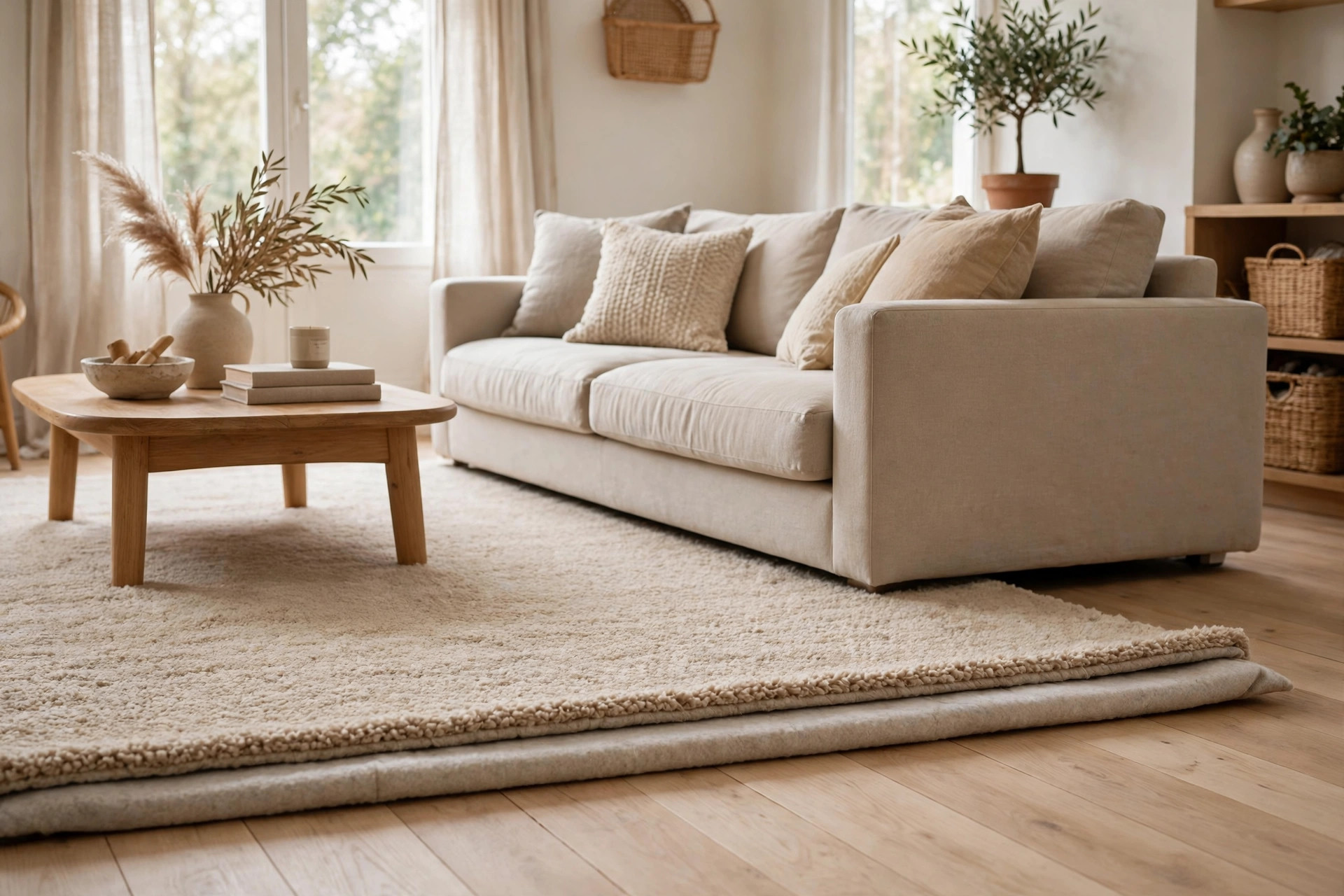
Why carpet feels like it works
Walk into a carpeted room and it feels quieter right away. Your own steps land soft, voices sound warmer, and the room loses that hard echo you get from bare wood or tile. It is easy to conclude that the carpet is soundproofing the floor. It is doing something real, but it is not the thing most people think it is.
Carpet changes how a room sounds to the people inside it. It does far less for the people in the room below. That gap between what you hear upstairs and what your downstairs neighbor hears is the whole story.
What carpet and padding actually do
Carpet helps with impact noise, the sound made when something hits the floor. A footstep, a dropped toy, a chair dragged across the room, all of these send a jolt straight into the floorboards. Carpet and the padding under it cushion that jolt before it reaches the structure, so less of it turns into sound in the room below.
The padding does most of this work. A thick dense pad under the carpet absorbs the blow of each step, while the carpet itself is the soft top layer that spreads the pressure out. A thin cheap pad will help a little, and a thick pad will help a lot more.
Carpet also calms echo inside the room. Bare hard floors bounce sound around, so voices and music ring a little longer than they should. Carpet soaks up some of that bounce, which is why a carpeted room feels calmer and easier to talk in. That is acoustic treatment, not soundproofing, and the difference matters.
What carpet cannot do
Carpet cannot stop airborne sound, the voices, music, and television that travel through the air and through the floor itself. Those sounds do not hit the floor and stop. They push on the whole floor assembly, joists and subfloor and ceiling below, and pass through to the room underneath. A soft layer on top does almost nothing to that path.
Blocking sound takes mass. A floor blocks voices and music because it is heavy and stiff, not because it is soft. Carpet adds almost no weight at all. Laying carpet over a light floor is like putting a blanket over a thin door and expecting the voices on the other side to vanish.
This is why people get disappointed. They carpet the whole upstairs, spend real money on it, and then hear the same voices and the same television from below. The footsteps got quieter, which is a genuine win, but the airborne sound barely changed, because carpet was never the tool for that job.
Rugs as a practical step
A rug works the same way carpet does, just in a smaller area. A thick rug with a dense pad under it softens footsteps where feet actually land, which is usually the walking path across a room and the space in front of a bed or a sofa. It is the fastest and cheapest version of the carpet fix, and it is a good first step if you are renting or not ready to recarpet a whole floor.
Place matters more than size. A rug in the middle of a room that nobody walks across does little, while a rug on the path from the bed to the door catches most of the morning footsteps. Layer a thick pad under the rug, not just the rug itself, because the pad is doing the heavy lifting.
Be honest about what a rug will not do. It will not stop voices, music, or a television from reaching the room below, and it will not fix a floor that carries every footstep like a drum. If the footsteps are the main complaint, a rug is a real fix. If the voices are the main complaint, the rug is only a start.
Underlayment is the real fix under a hard floor
If you love a hard floor and want to keep it, underlayment is the layer that does the carpet pad job underneath it. A resilient underlayment sits between the hard floor and the subfloor and cushions each step before the sound starts. It works the same way a carpet pad does, by breaking the hard contact between the walking surface and the structure.
Underlayment comes in many forms, from thin foam sheets to thicker rubber and cork layers, and the thicker and denser options generally do more for impact noise. Our guide to flooring underlayment explains what each type actually does about footstep noise, and when it is worth the cost.
One warning matters here. Underlayment is installed under the floor, which usually means lifting the floor to put it in. That makes it a bigger job than a rug, and a job to plan when the floor is already coming up for other reasons.
Seal the gaps at the edges
Sound is lazy, it takes the easiest path through a floor, and the easiest path is often a gap. Pipes that pass through the floor, vents, and the joint where the floor meets the wall all leave small openings, and sound slips through them.
Walk the room and look for those openings. Around a radiator pipe, around a vent grille, and along the baseboards, any place where you can see a crack or feel a draft is a place sound can pass. A flexible sealant in those gaps closes the path, and it costs very little.
When the floor needs a real fix
If the footsteps are softer and the voices still come through, the floor itself needs more than a soft layer. The real fixes add mass or break the rigid connection between the upstairs floor and the downstairs ceiling. A second layer of subfloor, a resilient channel under the ceiling below, or a decoupled ceiling all work on the structure, not on the surface, and that is why they work on airborne sound.
These are bigger jobs, and they are the point where a guess gets expensive. A short noise study can show which path the sound is actually taking, through the floor itself or through a gap or a flanking wall, and which fix matters most. Our guide to what a noise study is, and when you need one, explains what the study covers.
What to skip
Skip the idea that thicker carpet alone will fix a noisy floor. Carpet thickness helps with echo and with the feel of the room, but past a certain point extra pile does very little for the room below. The pad matters more than the pile, and no pile is a substitute for mass.
Skip acoustic foam on the floor. Foam sold for wall treatment does not belong underfoot, it crushes flat, and it does not block sound. It is the wrong material in the wrong place.
The order that works
Put it together in this order, and stop when the floor sounds right. First, put a thick pad under a rug on the walking paths, and see how much of the footstep noise goes away. Second, seal the gaps around pipes, vents, and baseboards. Third, if you are recarpeting or relaying a hard floor, put in the thickest pad or underlayment the floor allows.
If voices and music still come through after those three steps, that is the point to call us. The floor needs mass or a decoupled ceiling, and a short noise study will show which one. Request a free quote at silentical.com/quote/ or call (716) 330-1147. Tell us whether footsteps or voices are the bigger problem, what kind of floor you have, and what is underneath it, and we will tell you whether a rug, an underlayment, or a structural fix is the place to start.