
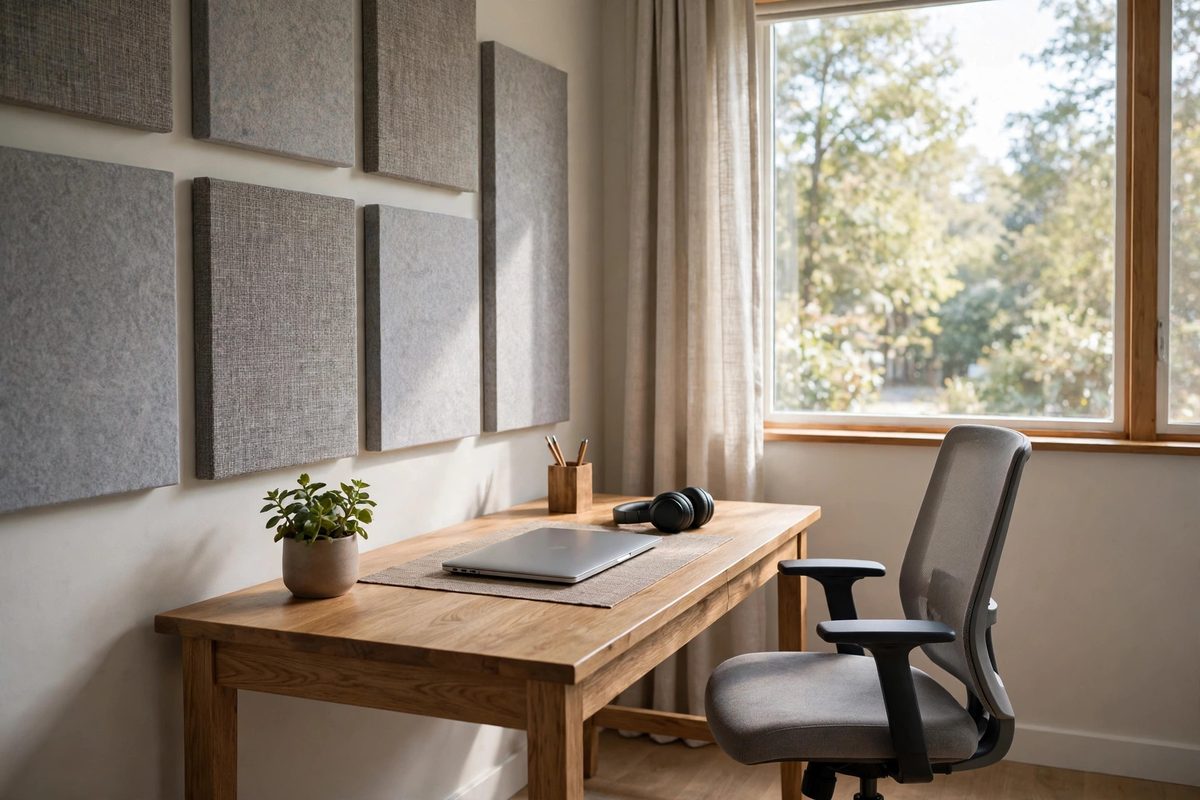
Working from home in Escondido or anywhere in North County, the enemy is rarely one big noise. It is the pileup: the gardener next door, kids in the living room, the freeway hum when the windows face the wrong way, and the barking dog that always seems to start right as your meeting does. A home office that cannot hold a quiet hour is not really an office.
Soundproofing is one of the most searched acoustic topics, and one of the most misunderstood. Here is what actually matters.
First: soundproofing is not acoustic treatment
Acoustic treatment changes how a room sounds from the inside. Panels on the walls calm the echo so your own voice does not bounce around. That is a good thing to do, and your calls will sound cleaner for it, but it will not stop your neighbor's leaf blower from reaching the microphone. That is a separate job.
Soundproofing blocks sound traveling in and out. It comes down to two things: mass and sealing. Heavy construction makes it harder for sound to push through a wall, and sealed gaps make sure sound has nowhere to sneak around it. If you remember one idea from this article, make it this: the weakest link decides everything. A wall can be built like a fortress, but if there is a gap under the door and an open vent, the sound walks right through those openings.
The three weak points in a home office
The door. This is almost always the biggest leak. Interior doors are hollow, which means they are light and thin, exactly the opposite of what blocks sound. Add an automatic door bottom, which drops a seal to the floor when the door closes, plus adhesive perimeter seals on the frame. The room instantly gets quieter, and so do your video calls for the people on the other end.
The windows. A single pane window lets traffic and neighborhood noise in almost freely. If replacing windows is not on the table, the next best thing is a secondary interior window, a second pane mounted in a separate frame with a decent air gap. It works on the same principle as double glazing, and it helps with both noise and insulation. Heavy curtains help a little with echo inside the room, but do not expect them to block much noise on their own.
The gaps you do not see. Outlets on shared walls, recessed lighting, the vent the office shares with the rest of the house, the gap where a cable runs through the wall. Sound finds every one of them. Sealing these is boring work and it is some of the most effective work you can do.
What about the wall itself?
Once the leaks are handled, adding mass is the real upgrade. A common approach is a second layer of drywall on resilient channels, which decouple the new layer from the studs so vibration has a harder time crossing over. Mass loaded vinyl, a thin dense sheet, can go between layers as an extra barrier without eating much wall depth. This is the level where a quick professional measurement pays for itself: every wall is different, and the noise source on the other side decides the fix.
Then treat the inside
With the room sealed, acoustic treatment finally earns its keep. A few fabric wrapped panels on the first reflection points cut the slap echo that makes video calls sound like they come from a stairwell. A rug with a thick pad under the desk handles the floor. This is the easy win, and it makes the sealed room pleasant instead of boxy.
When to call someone
DIY handles most home offices. But if your office shares a wall with a garage workshop, if you record music or podcasts there, or if the room has fundamental layout problems, that is where consulting starts saving money. A measurement takes the guesswork out: you find out exactly where the sound is entering, fix that, and stop buying products for problems you do not have.
Getting it right the first time
The order never changes: seal the gaps, fix the door and windows, add mass to the walls, then treat the room from the inside.
Silentical stocks both sides of the equation, from door seals and mass loaded vinyl to fabric wrapped panels, and every product ships through a quote cart so you only buy what your room actually needs. Or skip the guessing: our acoustical consulting team can measure your space and hand you a treatment plan that matches it.
Call us at (716) 330-1147 or start a quote online. A quiet office changes how you work.