
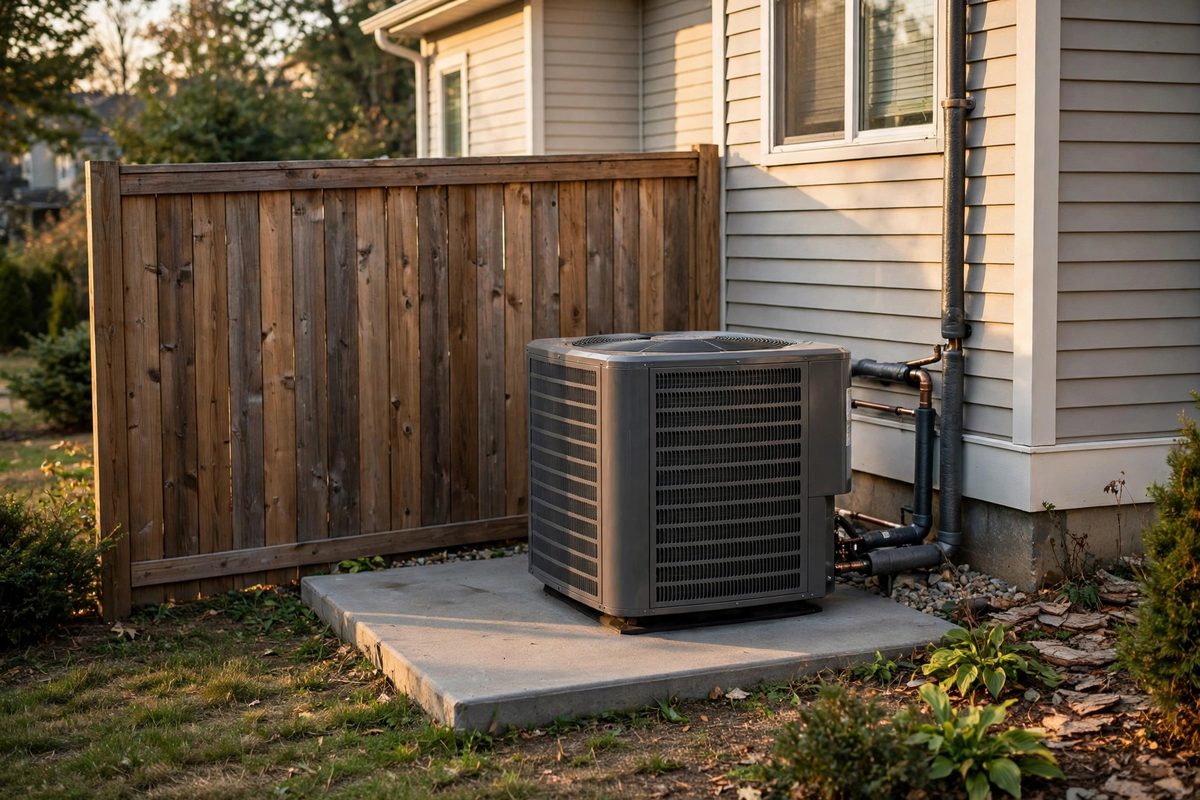
Your air conditioner hums. Your heat pump drones. If the outdoor unit sits near a property line, a bedroom window, or your own patio, that steady sound becomes the most annoying noise at the house. Not loud. Just constant.
The good news is that HVAC noise is one of the most solvable problems in this business. The source is small, fixed, and predictable. You do not need to rebuild anything. You need to think about placement, path, and vibration, in that order.
Why mechanical noise gets under your skin
An HVAC condenser makes two kinds of sound. The first is fan noise, a broadband whoosh that travels through the air. The second is the compressor hum, a low frequency tone. Low frequency sound is the stubborn one. It travels far, passes through fences and walls more easily than higher sounds, and it is the sound that keeps people up at night even when the level would measure as modest.
Placement does most of the work
Before you buy anything, look at where the unit sits. Sound fades as it travels, so every foot of distance between the unit and the nearest sensitive spot helps. Point the fan discharge away from neighboring windows and patios. Keep the unit out of corners, alcoves, and under low roofs. Any hard surface next to a unit reflects sound and makes it louder in that direction, the same way a cupped hand focuses your voice.
Vibration is half the problem
Here is the part most installers skip. A condenser bolted to a hard pad or a wooden deck shakes that surface, and the surface becomes a speaker. You hear it as structure borne vibration, a hum that travels through the deck boards, the wall, or the slab and shows up inside the house.
Vibration isolation fixes this. Flexible mounts or isolation pads go between the unit and whatever it sits on, so the shaking stays in the unit. It is a small part and a quick job, and it is the first thing worth checking any time an HVAC unit hums through a wall.
When you need a barrier
Sometimes distance is not available. Side yards around Escondido and most of San Diego can be narrow, and the unit has to go somewhere. A solid barrier between the unit and the receiver blocks the direct path of sound, but it only works under two conditions.
First, it must be solid, with no gaps. Air gaps leak sound the way a cracked door leaks light. Second, it must break the line of sight. A three foot fence in front of a five foot unit helps less than you would hope.
One caution: never box a unit in tightly. HVAC equipment needs airflow to work, and starving it causes real damage. A barrier screens one side. An enclosure is engineering, and it should be designed by someone who knows both acoustics and the equipment's airflow needs.
The neighbor conversation
Neighbor disputes over mechanical noise are some of the most common noise complaints we see, and most resolve faster than people expect. The unit is rarely "too loud" in any absolute sense. It is just pointed the wrong way, mounted the wrong way, or sitting too close to the wrong window.
If a neighbor has complained, or you are planning an installation near a property line, measured documentation helps both sides. A short noise study records what the unit actually produces at the property line or at the neighbor's window. That turns an argument about feelings into a conversation about facts, and it tells you exactly which fix will close the gap.
A practical checklist
If your HVAC noise is bothering you or your neighbors, work through this list in order. Move or reorient the unit if the location allows it. Isolate it from its mounting surface to kill the vibration path. Screen the direct line of sight to the receiver with a solid barrier. And only after all of that, if the problem persists, look at quieter equipment or a designed enclosure.
Get a read on your situation
If you are planning a heat pump install, if a neighbor has started mentioning the hum, or if your own bedrooms pick up the condenser at night, Silentical can measure what is actually reaching the affected spot and lay out the fixes in order of cost and effect. Call (716) 330-1147 and tell us where the unit sits and who is hearing it. Or send the details through the quote form for a proposal.