
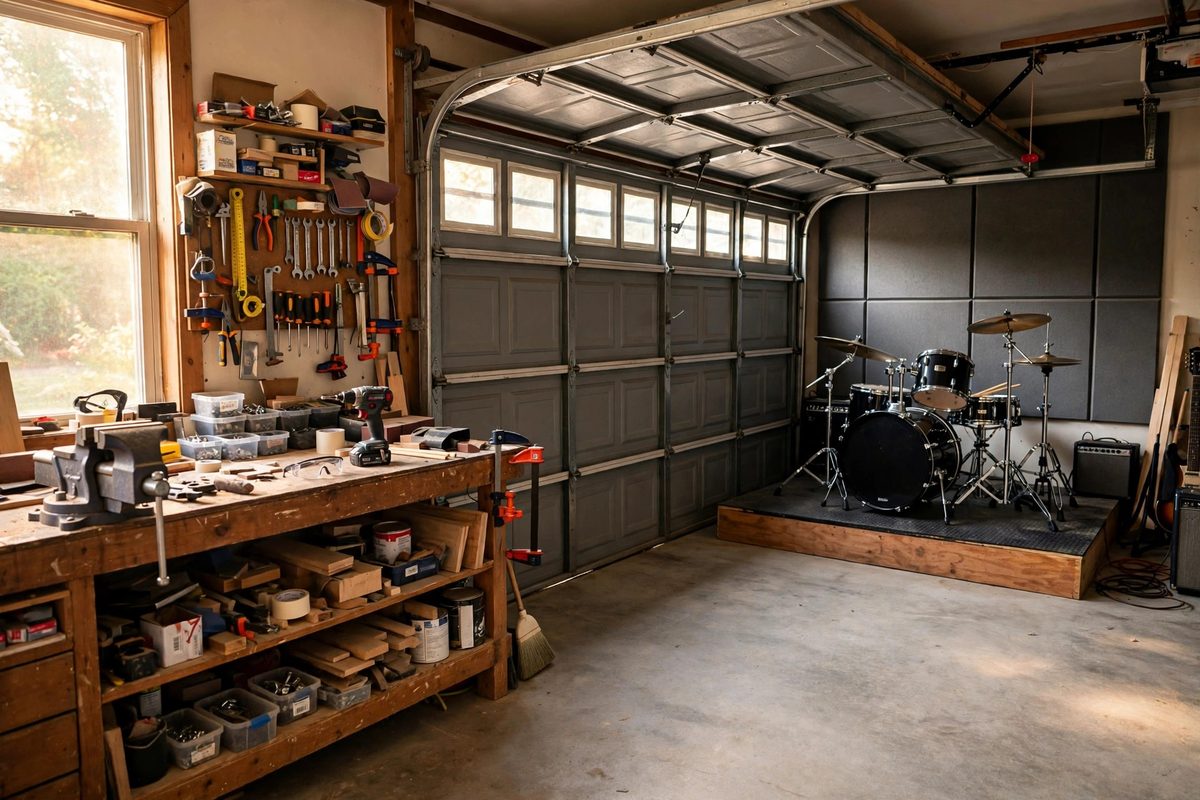
The garage is the loudest room in the house that was never designed to be a room. Thin walls, a thin door, gaps everywhere, and nothing inside to slow sound down. So when a teenager starts a band in there, or a table saw moves in, the whole neighborhood hears it.
Soundproofing a garage is absolutely doable, but garages are harder than spare bedrooms, and the fixes that work in a normal room sometimes fail here. It helps to know why.
A garage is a box made of shortcuts
Most garages are built to hold cars, not people. The walls are often single studs with drywall only on the house side, sometimes not even that. The big door is a thin metal slab with gaps around the edges, there is usually an unsealed gap under the side door, and sound takes every one of these exits. Inside, concrete floors and bare walls bounce sound around for a long time, which is why a drum kit in a garage sounds so much louder than the same kit in a carpeted bedroom. The room amplifies everything before it ever leaves the building.
Why people get garage soundproofing wrong
The most common mistake is treating the garage like an echo problem. People cover the walls with foam panels, the echo inside dies down, and the neighbors can still hear every song. The foam never was stopping sound from leaving. The second mistake is going after one big fix. A heavy new side door will not do much if the walls are single layer and the garage door frame is leaking. Sound finds the weakest path, and in garages there is always more than one weak path, so single fixes usually disappoint.
The order that actually works
Start with the gaps, because they are free or cheap and they matter more in a garage than anywhere else in the house. Seal the side door like any exterior door, with weatherstripping and a sweep that actually touches the floor. Seal the vents you do not need, close the attic opening, and caulk where walls meet the floor. This step does not make a garage quiet, but skipping it makes everything else less effective.
Next, deal with the garage door itself, because it is usually the single largest hole in the room. Replacing the worn weather seal around the frame and adding a good bottom seal cuts the most obvious leak. For serious projects, some people add mass to the door panels or build a heavy sliding panel that covers the door from the inside while the band plays. A garage door will never be as tight as a wall, but it can be made much less embarrassing.
Then add mass to the walls, where the real sound blocking happens. A second layer of drywall with damping material between the layers is the standard approach. Where the wall is open studs with no drywall at all, the first layer makes the biggest difference of anything you will do. Insulation in the cavities helps too, mostly by calming the hollow drum effect inside the wall.
Finally, calm the inside of the room down. Absorption on the walls and ceiling makes the room better for the people in it, protects hearing during practice, and keeps reflected sound from hitting the weak points at full strength.
The special case of bass
Bass is the hardest thing about garages. Drum kits, bass guitars, and subwoofers produce low frequencies that travel through walls and ground with ease, and no reasonable amount of drywall fully stops them. If the band has a loud drummer, be honest: you are reducing the noise, not eliminating it.
What helps most with bass is mass and distance. More drywall layers, a heavy door treatment, and keeping the loudest source away from the wall that faces the neighbor. A drum riser that decouples the kit from the concrete floor cuts the thump traveling through the slab, which is a real effect even if it is not a complete one.
A note on timing
Most San Diego area cities have noise ordinances with daytime and nighttime limits, and neighbors complain about garages first because garages project. A modest amount of treatment goes much further when the loudest playing happens in the afternoon instead of at ten at night. The same goes for saws and compressors in a workshop. Being considerate with the clock costs nothing and buys real goodwill.
When to get a professional involved
A garage that just needs to be a little quieter is a weekend project. A garage that needs to host regular rehearsals, lessons, or a home business is a design problem. The difference comes down to knowing which surfaces leak the most and how much mass each one needs, because perfect walls plus an ignored door is money spent badly.
If the complaints have already started, or the plan is a real rehearsal space, measure first. Silentical works with homeowners across Escondido and the San Diego area to sort out which garage leaks matter and in what order to fix them. Call (716) 330-1147 and tell us what is in the garage and who is hearing it, or send the details through the quote form for a proposal.