
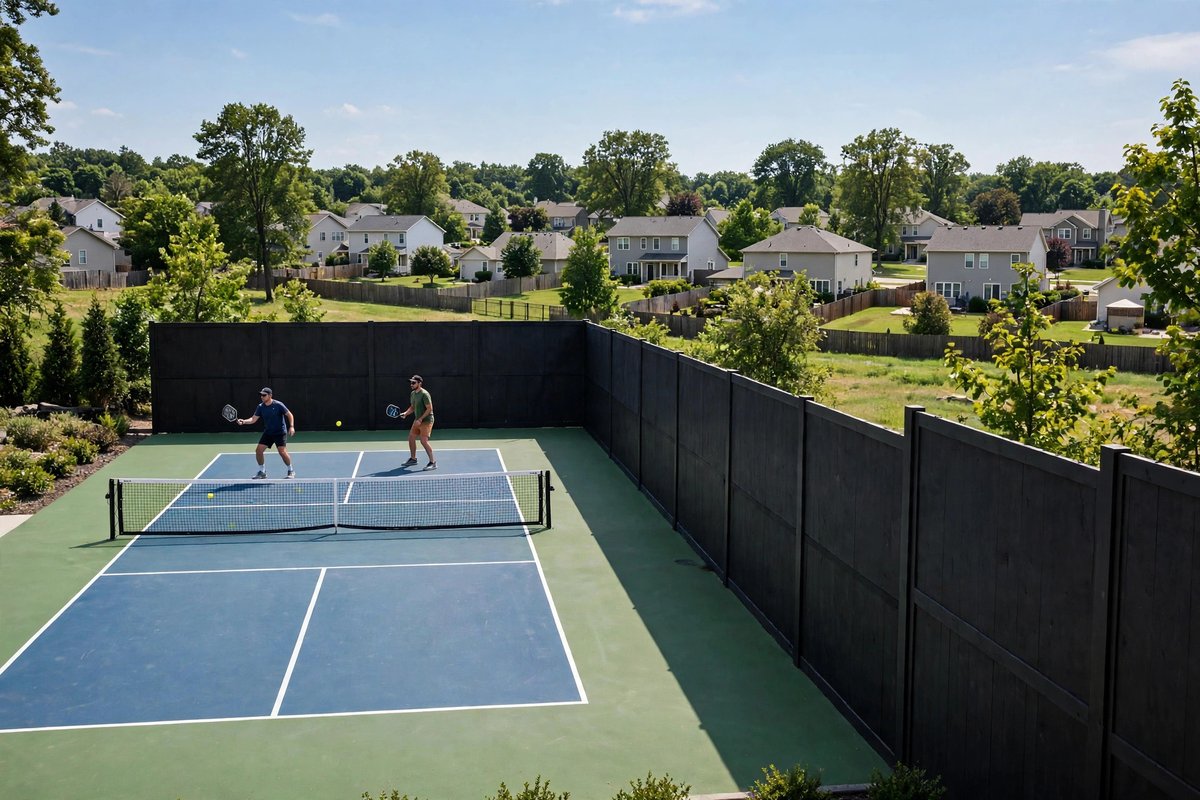
Pickleball is everywhere now, including all over San Diego County. New courts are going into parks, clubs, schools, and backyards, often a lot closer to homes than anyone expected. Then the complaints start: neighbors say they can hear every rally, all day, even with their windows closed. Both sides are usually telling the truth, because pickleball noise is different from most sports noise. Understanding why it carries so well is the first step to fixing it.
Why that pop is so hard to ignore
A pickleball is hard plastic, and the paddle is hard too. When they meet, they make a short, sharp pop, very different from the softer thud of a tennis ball. Sharp, sudden sounds stand out against ordinary background noise, which is why it carries, even at a distance.
Then there is the repetition. A single pop would be easy to ignore, but a rally is dozens of pops, and a busy court can keep that going for hours. The ear tunes out steady sound, like traffic hum, far more easily than a sound that starts and stops, over and over.
Distance helps, but not as much as people hope. A sharp, repeated sound can still be clearly audible from a neighboring yard or an open window, especially in the morning or evening when the neighborhood is quiet.
What does not work on its own
The most common first fix is planting a hedge or a row of trees. It looks nice, but greenery on its own does very little to block sound, since sound passes through gaps between leaves and branches. Landscaping works best next to a real barrier, not as the barrier itself. A standard chain link fence does not help either, since sound goes straight through the open mesh.
What actually helps, starting at the source
The most effective fixes start where the sound is made. Quieter paddles and balls are the simplest change. Softer-impact equipment makes a noticeably duller sound at the point of contact, and some clubs keep a set of quieter equipment for early morning or evening play. It does not silence the game, but it takes the edge off the sharpest part of the sound. A more cushioned court surface helps in the same way, absorbing some impact energy instead of bouncing it back.
Barriers that are built to block sound
When a barrier is needed, it has to be solid, heavy, and without gaps. Purpose built acoustic fencing and sound walls work on a simple principle: mass blocks sound. A heavy, continuous panel will do far more than a light screen or a fence with holes in it.
Three details decide whether a barrier works. It should sit as close to the court as practical, blocking sound before it spreads. It should be tall enough to break the direct path to the neighboring homes. And it must be continuous, with no gaps, because sound will find the gap and pour through it. Barriers should therefore be planned before a court is built; retrofitting one can run into permits and setback rules.
Hours, layout, and honest measurement
Not every fix is physical. Agreed playing hours are free, and they often do more for neighbor relations than any single product. Most friction comes from early morning and late evening play, when homes are quiet and people are trying to sleep or wind down. Respecting those hours shows good faith and can keep a disagreement from turning into a formal complaint.
Finally, if there is a real dispute, measurement beats argument. A proper noise assessment listens at the places that matter, usually at the property line and at the neighboring home, during actual play, and compares what is heard with the local rules that apply. That gives everyone the same facts to work from, instead of guesses that lead to money spent on the wrong fix.
A good neighbor and a good game are not opposites
Pickleball is not going away, and neighbors are not wrong for wanting some peace in their own yards. The courts that work best are the ones where noise was thought about from the start: quieter equipment, a real barrier where one is needed, sensible hours, and a layout that gives homes some breathing room.
If you are planning a court in the San Diego or Escondido area, or you are already fielding complaints about one, we can help. We visit the site, listen during real play, and lay out in plain terms what would actually quiet it down, so players, neighbors, and clubs can agree on a fix.
Browse the shop and send us a quote request through the website, or call us at (716) 330-1147 to arrange a consultation. A court that sounds better is a court everyone can live with.